
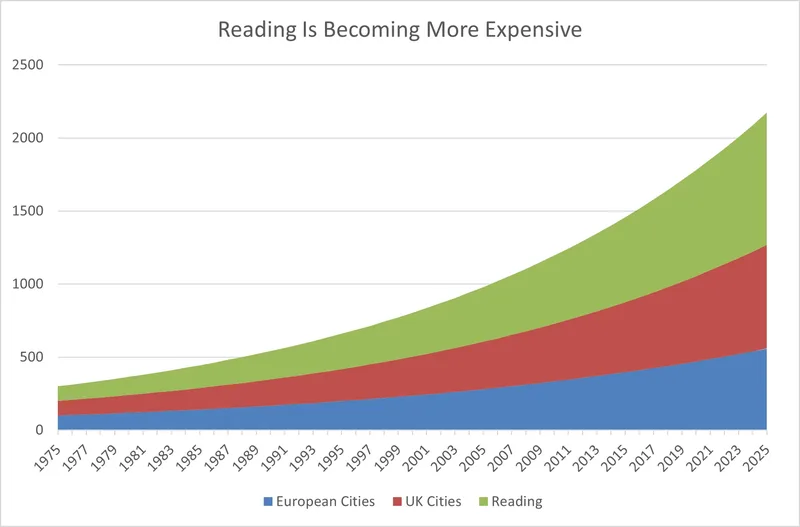
I'm sure that all readers of this magazine wake up at least once a week and wonder why everything is so darn expensive, so this month we're taking a deep dive on why living in Reading (or anywhere else in the UK) seems so expensive nowadays.
Inevitably, there are a myriad of reasons why each item on your bank statement every month seems to only go sharply in one direction, but let's start with the big picture. The essential problem is that fewer than half the people in the UK pay for the other half.
According to the Office for National Statistics, 47.4% of people in the UK live in households that are net contributors—meaning they pay more in taxes than they receive in benefits and public service, whilst 52.6% of people in the UK are net recipients, living in households that receive more from the state (in benefits and public services) than they contribute in taxes.
There are no exact figures for how this breaks down in Reading but based on councils tax payments the figures in Reading is 59% contributors against 41% recipients, so the balance is more positive than elsewhere in the UK. Nevertheless, three quarters of the council's budget goes on providing housing and social care.
There are now a scary number of people in the UK not in employment, education or training who are economically inactive and not contributing to taxes, meaning that the cost of the NHS, education, defence and everything else is a burden on a smaller part of the population. Where unemployment was once an issue, inactivity is now the problem.
Just under a million 16-24 year olds in the UK are not in education, employment or training – that’s around 13.4% and this is increasing rapidly. Again, there are no reliable figures for Reading, but the estimate is that it is similar to the national average. But a further 9.19 million people of working age (17-64) are not active, due to caring for others, long term sickness or early retirement. Given that a further 24.5 million people are children or retired, you can begin to see the problem. Over thirty five million people do not work in the UK and many who do cost the country through Universal Credit.
In the meantime, we have been consuming more education, health and social care. We are more idle, meaning that we work less and provide more of a drain on the NHS, we live longer, so this means that we are also a drain on the rest of society. In the meantime countries like Spain and Ireland have become much wealthier than us.
Local councils used to be powerful, but their responsibilities were stymied by Thatcher in her ideological battle againsy the Greater London Council. She left local councils with all of the responsibilities but none of the powers, and Blair hardly reversed this. This is one of the major reasons our council tax fees keep going up. The cost of looking after the most vulnerable people in our society.
Over the past five years, the average Band D bill in Reading has likely risen from around £1,900 in 2020/21 to over £2,200 in 2024/25, with a further rise of 4.99% set for next year. Here's a breakdown of how your money is spent and raised.
|
Service Area |
% of Net Budget |
Approx. £m |
|
Children’s Services |
37% |
65.3 |
|
Communities & Adult Social Care |
36% |
64.6 |
|
Economic Growth & Neighbourhood Services |
12% |
21 |
|
Resources |
11% |
20.2 |
|
Corporate Budgets |
3% |
5.5 |
|
Chief Executive Services |
1% |
1.5 |
|
Total |
100% |
178.1 |
|
Funding |
||
|
71% Council Tax |
||
|
27% Business Rates & Tax |
||
|
2% Other Income |
Then there are those darned utility bills. Did you know that in Reading, Berkshire, England we typically pay four times more for your domestic electricity than a resident of Reading, Berkshire, Pennsylvania, USA ? There are a few reasons for this - the US is a net exporter of energy thanks to shale oil and fracking, but UK energy bills are huge because they are pegged against the most expensive supply, which is, ironically, imported gas from the USA, so we are vastly overpaying for much cheaper sources of energy such as wind and solar. Also, our energy distribution and storage is very poor, so very often we cannot use the renewable energy that we generate.
Ofgem’s price cap, reset every quarter, puts the annual cost of dual-fuel energy for a “typical” household at £1,849 between April and June; it is set to fall to £1,720 from July, still a tenth higher than a year ago. Spread evenly, that is roughly £143 a month.
Water, once an utility us Brits barely noticed, is now marching in lock-step with electricity and gas. Average charges will rise by an average £123, or 26%, this financial year, lifting a standard bill to about £603—more than £50 a month. Here in Thames Water territory, some un-metered customers face even steeper increases as old tariffs are unwound. The reasons for this have been covered ad nauseum on these pages - asset stripping by shareholders in the form of dividends after Thatcher's privatisations.
Add broadband—about £25 for a mid-speed fibre line—and home insurance, and a modest household is laying out well over £500 a month before it has paid the rent or mortgage.
And it's housing that hurts most of all.
Private rents in Reading have climbed by 11.3% in the past year to an average of £1,532 a month, well above the national mean of £1,386. Buying is scarcely kinder. The average home changes hands at £348,000, up 4.8% year-on-year. With two-year fixed mortgage rates on 90%-loan-to-value deals hovering around 5.3%, a first-time buyer with a 15% deposit faces repayments of roughly £1,400 a month on a standard 25-year term, roughly equivalent to rent but with the addition of freehold fees and maintenance.
So, just to have access to a roof over your head with some energy you're talking about £2000, which means that you (or you and your family) needs to earn £30,000 before paying for food, entertainment, holidays or transport.
Motoring costs continue to rise - although second hand cars have come down sharply in value. Insurance is likely to cost £500-1000, road tax is to see a big hike this year for EVs, and stands at around £200 pa. Then there is servicing, MOT, fuel or electricity and, of course, the cost of the vehicle itself. And the cost of parking in Reading is amongst the highest outside London.
You may therefore be grateful for Reading Buses, but even their charges are rising rapidly as government subsidies are cut back.
And let's not even mention rail travel, with Reading one of the most expensive places in the world to board a train at around 53p a mile. If you consider that the average cost per mile in Europe is just 14p, then this is another massive cost difference that commuters and travellers have to pay for. Rail travel from Reading to London is one of the most expensive commutes in the whole wide world.
Since the pandemic it seems that there is a lot less going out with pubs all over Reading closing down, even if the night time economy is healthier than elsewhere in the UK where clubs, nightclubs and music venues have been closing at an alarming rate. Still, over the past fifty years, the cost of a pint in a Reading pub has risen dramatically. In 1973, the average price of a pint of draught beer in our town was about 13p. As of 2025, the average price of a pint in Reading is around £5.20. In percentage terms, this is a staggering rise of approximately 3,877%.
But the cost of staying in piles up.
Streaming prices have risen sharply: Netflix's standard plan rose by £2 in the past year, and premium by £4. Disney+ and Amazon have also increased prices, with projections of further rises.
If you have the main basic paid for streaming services plus Spotify, it will cost you around £65 a month before sport, which can easily add another £70-100 a month.
And if you order in food, the average cost of a takeaway or delivery in Reading has risen by 40% since the pandemic.
Then there is government incompetence and cheating by people who should be contributing to our society.
Tax not recovered by HMRC was £46.8bn in 2024, nearly half at £19bn was corporation tax from small companies. That means your tax is higher and the NHS and education have less money. It is pretty obvious that government institutions such as ONS and HMRC are not fit for purpose. But tradespeople avoiding tax are costing those of us who actually pay our full tax badly. Refuse to pay cash and this would quickly get sorted.
Reading BC does a good job in recovering council tax with just a £2m shortfall last year. However, figures for unpaid rates, parking, rent and other costs are not published. We believe that it is fair to extrapolate that the council - and all of us ratepayers - are swindled from £10-12m a year.
So why has life become so dear? The first culprit is politics, where big corporations seem to rule, online, in energy production and beyond.
The second is Thatcher's asset strippers - Thames Water paid huge premiums to shareholders whilst not investing in infrastructure.
We've already covered why council taxes are going up - housing and social care bills.
We tried austerity and it was as disastrous as Thatcher's monetarism. On the other hand, Labour rebels believe that we have enough money to throw at any issue. So, what do we do ? Well, it seems that the only current solution British people have is to vote for the people who gave us Brexit and seem to have no coherent policies whatsoever other than blaming immigrants rather than blaming themselves and their children. Perhaps doing away totally with universal credit and housing benefit is the only way to Make Britain Great Again.
The reality is that like most Brits, Readingensians are lazy and want to blame everyone else for everything since they have little or no control over the things that really influence their lives.


Comments
No comments yet. Be the first to share your thoughts.
Join the conversation
Log in to leave a comment on inReading.