

Reading residents are divided on the impact of graffiti and tagging.
Since lockdown, graffiti and tagging have become much more prominent on the urban landscape of Reading. But is this a form of artistic expression or just vandalism? In Reading, residents seem split on the role of graffiti in shaping the town's aesthetic and social landscape.
But this is nothing new. Graffiti, sometimes termed as the 'voice of the voiceless', has a storied history that stretches back to the dawn of human civilization. The earliest form of this expressive art can be traced to prehistoric times, when our ancestors adorned cave walls with intricate drawings. These primitive images, like those found in the Lascaux Caves in France, served as means of communication and spiritual beliefs. Far from being mere vandalism, these early expressions laid the groundwork for what would become a complex and controversial form of art.

As civilizations advanced, so did the methods and purposes of graffiti. The ancient Greeks and Romans carved messages into stone walls, often to mark ownership, declare love, or make political statements - graffiti was present on barrels found in the nearby Silchester Roman settlement - perhaps Reading’s original Banksy moment.
In Pompeii, preserved under volcanic ash, graffiti was important in revealing a society much like our own, with scribbles that range from the mundane to the profound. The etchings and voice of individuals who may otherwise have faded into obscurity, resonating down the years and providing valuable insights into the past.
The modern era of graffiti began to take shape in the early 20th century. During World War II, "Kilroy was here" became an iconic phrase, scrawled by American soldiers in far-flung locations, symbolizing presence and solidarity. This period marked a shift from mere markings to more symbolic and political messages.
The true explosion of modern graffiti occurred in the 1960s and 1970s in the urban landscapes of New York City and Philadelphia. This era saw the rise of "tagging," a style characterized by the writing of the tagger’s name or pseudonym in a stylized manner. Cornbread, widely recognized as one of the first modern graffiti artists, began tagging his name around Philadelphia to garner attention. This was more than mere mischief; it was a declaration of existence and identity.
New York City soon became the epicenter of the graffiti movement. The subway cars and building walls of the city provided vast canvases for artists eager to express themselves. TAKI 183, a Greek-American teenager, gained notoriety for his ubiquitous tags across Manhattan, inspiring a new generation of graffiti writers. This period saw the emergence of colorful, large-scale works known as "pieces" (short for masterpieces), which required significant time and skill, elevating graffiti from simple tags to elaborate murals.
Graffiti's evolution continued through the 1980s and 1990s, with artists like Jean-Michel Basquiat and Keith Haring bringing street art into galleries and museums. Basquiat, starting with graffiti under the name SAMO, and Haring, with his distinctive chalk drawings in subway stations, bridged the gap between street culture and the mainstream art world. Their works, infused with social and political commentary, challenged traditional notions of art and its place in society.
Despite growing acceptance in the art world, graffiti has remained a polarizing subject. Towns and cities worldwide grapple with the dichotomy of graffiti as both vandalism and art. The implementation of anti-graffiti laws and the use of surveillance technologies reflect the ongoing tension between property rights and artistic expression. Some places have embraced graffiti, designating legal walls and commissioning murals to beautify urban spaces. Initiatives like the Wynwood Walls in Miami and the East Side Gallery in Berlin, where a section of the Berlin Wall is preserved and adorned with murals, illustrate this complex relationship.
Street culture, encompassing not just graffiti but also hip-hop, skateboarding, and punk rock, has played a crucial role in shaping modern graffiti. This culture values rebellion, self-expression, and community, principles that are vividly embodied in graffiti. The art form serves as a visual manifestation of the struggles and aspirations of marginalized communities, providing a powerful platform for social commentary - the voice of the voiceless.

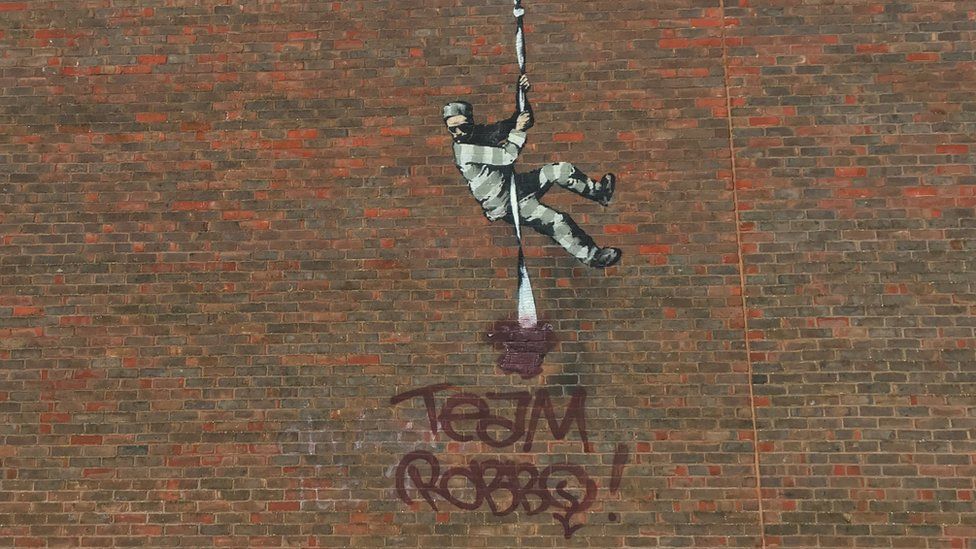
Artists like Banksy and local creative Peachy have taken graffiti to new levels, using stencils and physical installations to create thought-provoking pieces that critique social and political issues. Banksy's anonymity and clever use of public spaces have earned him international acclaim, blurring the lines between vandalism and high art, including the escaped prisoner on the walls of Reading gaol in 2019.
This graffiti was 'vandalised' by followers of rival graffiti artist Robbo, who had beef with Banksy going back decades after Banksy drew over an existing Robbo design in a tunnel on the Grand Union canal in Camden Town. Graffiti is vandalised...
The digital age has also birthed new forms of graffiti, with virtual tags and augmented reality experiences. Graffiti artists now share their work on social media, reaching audiences far beyond their local neighborhoods and influencing a global community of artists and enthusiasts.
But is it art, the human need for self expression, or just sheer vandalism ? Recent data from a UK urban art survey revealed that 60% of respondents view graffiti positively, considering it a vibrant form of urban art that adds character to public spaces. However, 40% expressed concerns about graffiti contributing to a sense of urban decay and detracting from the city's overall appeal.
Sarah, a local Reading artist, believes that graffiti has the power to transform mundane spaces into vibrant art galleries. "I see graffiti as a means of self-expression and community storytelling. It has the potential to spark conversations and evoke emotions," she passionately stated.
In contrast, Mark, a long-time resident of our town, voiced his worries about graffiti perpetuating a negative image of the city. "While some graffiti may be beautiful, much of it is simply vandalism that degrades our neighborhoods. We need to find a balance," he emphasized.
City officials in Reading are exploring ways to harness the positive aspects of graffiti while addressing concerns about unauthorized tagging and property damage. Initiatives such as designated graffiti walls and community art projects are being considered to channel creative energies in a constructive direction.
As Reading navigates the complex terrain of urban art, we will all need to continue to engage in dialogues to find common ground and foster a sense of shared ownership over the city's visual identity. Art or vandalism ?

Comments
No comments yet. Be the first to share your thoughts.
Join the conversation
Log in to leave a comment on inReading.