
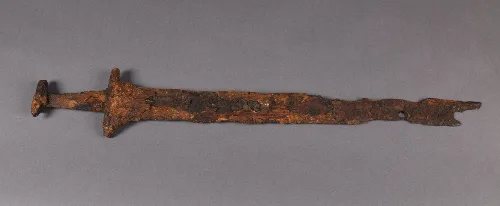
From the original settlers who crossed the land bridge from Europe to the Romans, the Saxons and the Normans, the Thames Valley, with its strategic waterways and fertile lands, has played a role in England’s history and Reading became a significant focal point during the Viking invasions of the late 9th century.
The Vikings, primarily from Denmark and Norway, first began raiding England in the late 8th century. Their early attacks were focused on monasteries, such as the infamous sacking of Lindisfarne in 793 AD. Over time, these sporadic raids evolved into full-scale invasions with armies ‘wintering’ in secure locations in the British Isles.
By the mid-9th century, Viking forces had shifted from plundering coastal sites to deeper inland incursions, making use of rivers such as the Thames to penetrate the heart of England. The Great Heathen Army, a formidable Viking force, landed in England in 865 AD and began a campaign of conquest across the Anglo-Saxon kingdoms.
In late 870 AD, a significant Viking army, under the command of kings Bagsecg and Halfdan Ragnarsson, arrived in the Thames Valley and established a fortified base in Reading (probably in the area now beyond the prison and Reading Bridge) where they could camp over winter. The town’s location at the confluence of the Thames and Kennet rivers made it an ideal stronghold, providing access to both waterways and fertile lands. Furnished burials at Reading and Sonning, on opposite banks of the Thames, and a hoard of coins deposited ‘in a coffin’ in St Mary’s churchyard in Reading, have been associated with the are relics of the over-wintering of the army. Once a camp was established the army did not remain closeted there all winter. Raiding forays were made from the camps – including one in 870 which was encountered by Ealderman Æthelwulf and the Berkshire fyrd (local army or militia). The local villagers literally lived with the enemies at their door.
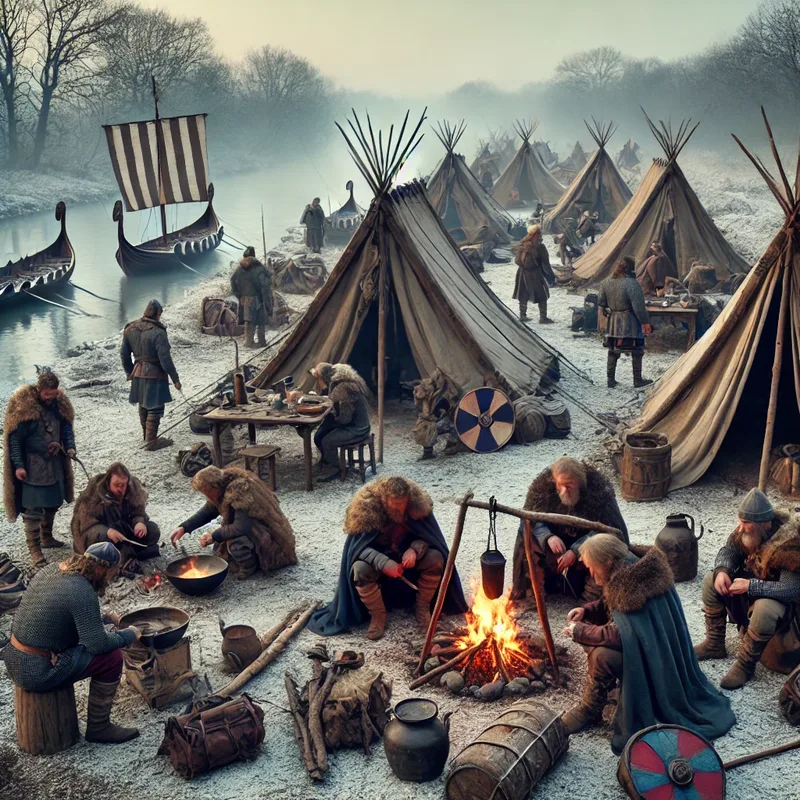
Reading was a critical point for Viking operations because the Thames allowed easy movement of Viking longships, which with their shallow hulls could navigate up the Thames and its rapids, whilst the River Kennet provided additional access to western Saxon lands. Plus, by building a ditch and fortifications facing west into where the current town stands, the location was defensible and well-positioned for further raids into Wessex.
The Battle of Reading (4 January 871 AD)
King Æthelred of Wessex and his younger brother, Alfred (later King Alfred the Great), led an army to confront the Vikings at Reading. Initially, Saxon forces scored a minor victory at Englefield, a nearby skirmish led by Ealdorman Æthelwulf. However, the main battle at Reading proved disastrous for the Saxons.
The Vikings' strongly fortified positions using earthworks and trenches and ditches created a formidable barrier between the Thames and Kennet rivers. When the Saxons attacked, they were repelled with heavy losses, and Æthelwulf was killed in the fighting. The Viking victory at Reading marked a crucial moment in their campaign, as it secured their foothold in Wessex - for a while.
The Aftermath: The War for Wessex
Despite their defeat at Reading, the Saxons continued their resistance. Just days later, the two armies clashed again at the Battle of Ashdown (January 871 AD), where Alfred played a key role in securing a West Saxon victory. However, this did not drive the Vikings out permanently. Over the following years, the Norse forces engaged in a series of battles across Wessex before eventually making peace.
By the late 9th century, the Vikings had carved out significant territories across England, leading to the establishment of the Danelaw. While Wessex remained independent under Alfred’s leadership, Viking influence persisted in the Thames Valley for some time until the massacre of the settled Vikings on St Brice's Day in 1002.
The Viking Legacy
While Reading and the surrounding Thames Valley were not part of the long-term Viking-ruled Danelaw, Norse presence in the region influenced trade, culture, and settlement patterns.
While Viking influence on place names in Berkshire and Oxfordshire is less prominent than in areas like Yorkshire, some Norse-derived names and linguistic influences may have persisted. Place names with the suffix “-thorpe” (a Norse term for a small village) or references to Norse gods are indicators of Viking presence. Vastern (Western)Road is one specific name that has survived the centuries and the word for islands in the Thames – ‘eyes’ is of Norse origin.
Viking-era finds, such as weapons, coins, and tools, have been discovered along the Thames Valley, suggesting trade and minor settlements. Recent discoveries in the region include Norse-style burials and artefacts indicating Viking activity beyond mere military incursions.

In 1895, a Viking iron axehead with remnants of its wooden shaft was discovered in the River Thames at Sonning, near Reading. It is currently displayed in the Story of Reading Gallery at Reading Museum.
In 2008, during excavations near St John’s College in Oxford, archaeologists uncovered a mass grave containing the remains of 37 individuals. These skeletons, dated to the late 10th or early 11th century, are believed to be Viking raiders who were victims of the St Brice’s Day Massacre 13 November 1002, when King Æthelred the Unready, fearing an imminent Viking uprising, issued a decree to kill all Danes living in England. This was in response to increasing Viking raids and concerns that the Norse settlers might align with incoming Viking armies. This probably marked the end of any significant Viking settlements in the Thames Valley.
There were other legacies, with the Norse incursions into Wessex influencing defensive strategies, leading to the creation of burhs (fortified towns) under Alfred’s rule, and the spread of Viking trade routes and goods through Reading and the Thames Valley helped shape economic networks that endured beyond their presence.
https://www.readingmuseum.org.uk/blog/vikings-reading

Comments
No comments yet. Be the first to share your thoughts.
Join the conversation
Log in to leave a comment on inReading.