
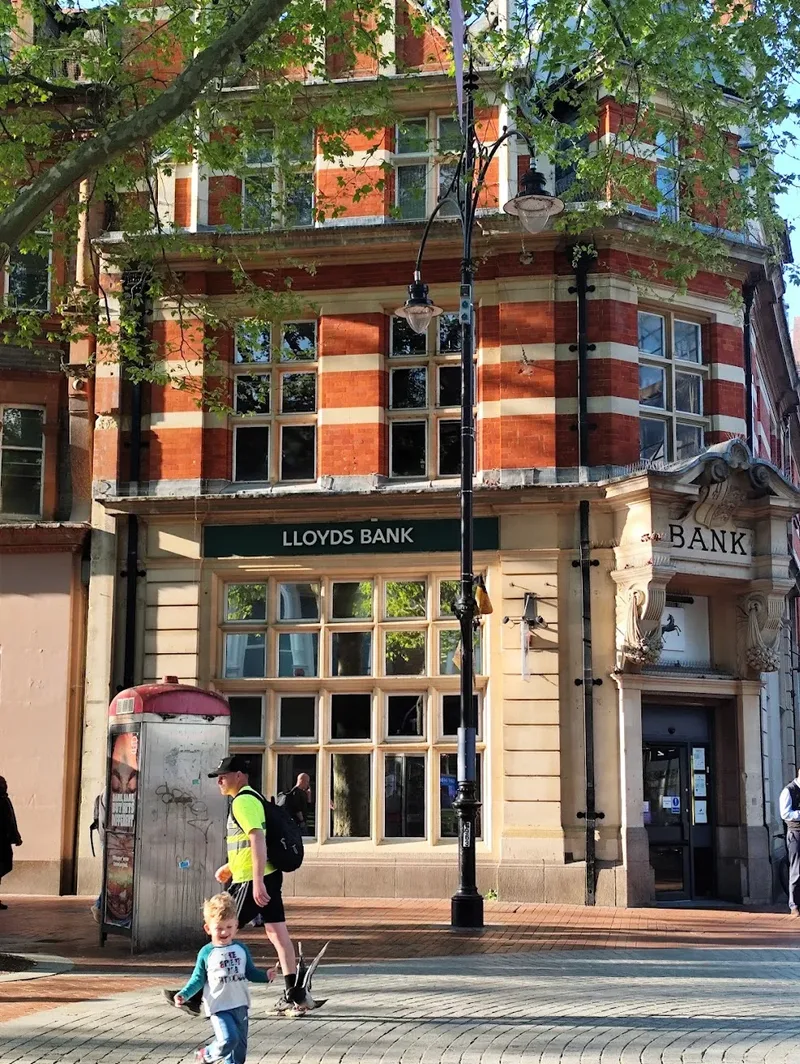
As the final bank branch in Woodley prepares to close, the steady disappearance of everyday banking is an issue for many DIngs. Access to cash, in-person advice, and basic services has been reduced to a small number of branches and Post Offices.
Financial activity in the area can be traced back to the 12th century, when Reading Abbey operated as a centre of economic administration. It managed land, collected revenues, and even operated a mint under royal authority. It had its own treasury on the second story between the South Transept and the Chapter House where valuables, coins, documents and books were kept.
In later centuries, local banking became more commercial. By the late 18th century, local institutions such as the Simonds Bank were serving regional businesses and issuing their own banknotes. The bank, founded by the brewing family was founded in 1791 by William Blackall Simonds and amalgamated with Barclays Bank in 1913.
Other local banks included Stephens, Blandy and Co., set up in the late 1700s by the Stephens and Blandy families and acquired by Lloyds Bank in 1889.
The Reading Savings Bank was established as a mutual society in 1817 by local Trustees and was eventually absorbed into the TSB (Trustee Savings Bank) network.
J & C Simonds and Co. was founded in 1814 by John & Charles Simonds as a spin-off/re-founding of the original Simonds Bank, this was also eventually merged into Barclays.
Reading & High Wycombe Building Society was another local mutual society. For much of the early 20th century, it was the go-to institution for local workers looking to buy homes in the Berkshire and Buckinghamshire area. In December 1956, the Reading & High Wycombe Building Society merged into the Bristol & West Building Society - part of a larger trend where regional societies joined forces to compete with national players. Then Bristol & West was bought by the Bank of Ireland in 1997. Later, in 2009, the branch network and savings business of Bristol & West were transferred to the Britannia Building Society and Britannia then merged with the Co-operative Bank.
During the 1980s and 1990s, all major banks and building societies maintained a presence in Reading town centre. At one point there were nearly fifty branches in the area, at a time when banking relied on in-person services, local decision-making, and regular customer interaction.
From the 1990s onwards, this expansive branch network in the town began to unwind. Digital banking reduced demand for physical branches, and banks consolidated their networks. Building societies were taken over by banks. Closures followed in sequence. Today there are fewer than twenty bank branches in the area, although Indian bank ICICI recently bucked the trend by opening a branch on Kings Road. The Barclays Bank on Broad St became The Botanist, the Lloyds Bank in Market Place became Market House. The old advertising slogan that 'your bank has become a nice wine bar' was very true in Reading.
But as this quiet decline was happening, a much larger scandal was unfolding in an unassuming bank branch in Reading. - during the early decades of the 21st century, the town has been at the centre of one of the most serious banking frauds in modern British history.
High Street Branch
In the early years of the 21st century, a major banking scandal unfolded in Reading that exposed profound failures within Britain’s financial system. Centred on the Reading branch of HBOS (Halifax Bank of Scotland), the affair combined fraud, corruption, regulatory failure and institutional denial. Its consequences were devastating—not only for small business owners, but also for high-profile figures such as Noel Edmonds.
At first glance, the HBOS branch in Reading appeared typical of a regional banking hub. Behind its operations, however, a coordinated fraud was developing within the bank’s Impaired Assets Office, a division intended to support struggling businesses. But instead of recovery, the unit became a mechanism for extraction.
The central figure behind the scandal was Lynden Scourfield, a senior manager with authority over distressed business lending. He worked closely with David Mills, a turnaround consultant later described in court as having "an unusually exploitative role" in the relationship.
The fraud followed a consistent pattern: businesses in difficulty were directed toward a specific consultancy, Quayside Corporate Services. Large and often inappropriate loans were approved under the premise of restructuring, with high consultancy fees imposed, rapidly draining company resources. As a result, businesses collapsed under the combined weight of debt and fees.
The outcome was predictable. Companies failed, owners were left insolvent and funds were diverted through the consultancy network to those involved in the scheme to fund lifestyles that included luxury travel, expensive assets, and personal excess.
The consequences extended beyond financial loss. Many business owners lost livelihoods, homes, and long-standing enterprises.
The scale was immense. The fraud is estimated to have cost around £245 million, with dozens of small and medium-sized enterprises driven into insolvency.
One of the most prominent cases was that of Noel Edmonds. His company encountered the Reading operation during the mid-2000s, after which he argued that its decline was directly linked to the fraud. He later described severe personal strain, including a period of acute mental distress. Over time, he became the most visible public advocate for victims, pursuing compensation from Lloyds Banking Group, which acquired HBOS in 2009.
His campaign brought sustained attention to the issue, including public criticism of the bank’s handling of compensation.
Early Warnings and Internal Suppression
Concerns about the Reading operation had been raised years before formal action was taken.
Among the earliest and most persistent whistleblowers were Paul and Nikki Turner, whose own business had been affected by the practices at the branch. After investigating independently, they compiled evidence linking internal bank decisions with external consultancy activity. Despite presenting this material to authorities, progress was slow. It was not until 2011 that Thames Valley Police launched a formal investigation into their claims.
At the same time, internal concerns were also being documented. In 2013, a senior risk officer, Sally Masterton, produced a report indicating that the bank had prior knowledge of serious issues connected to Reading. The report was initially dismissed. Masterton later exited the organisation, though the bank subsequently acknowledged that her work had been produced in good faith.
Criminal Proceedings and Convictions
The case reached court in 2017. Six individuals were convicted and received a combined total of 47 years in prison. Lynden Scourfield was jailed for 11 years and 3 months, David Mills for 15 years and Mark Dobson for four and a half years
The judge described the activity as "sustained and deliberate exploitation of legitimate businesses".
Following the convictions, Lloyds Banking Group established a compensation process known as the Griggs Review, but this process was widely criticised by victims and independent observers, who argued that it understated losses and applied restrictive methodologies.
A subsequent independent review in 2019 identified significant shortcomings in the original compensation scheme.
Over time, the total financial impact on the bank has grown substantially. By 2026, estimated costs, including compensation and associated expenses, have reached approximately £1.3 billion.
Despite this, many affected individuals maintain that financial settlements have not addressed the full extent of the damage to this day.
The Dobbs Review and Unresolved Questions
Attention has since shifted to questions of institutional accountability.
In 2017, an independent review was commissioned to examine whether senior executives were aware of the fraud and whether there had been any failure to disclose it appropriately.
But even as of today (April 2026), the review has not been fully published.
The delay has been attributed to the scale of documentation and the process of allowing individuals named in the report to respond prior to release. However, the length of time involved has led to criticism from politicians, campaign groups, and victims. Concerns remain that any eventual publication may be limited in scope.
From Banking Hub to Banking Desert
Meanwhile, as we all know, banking has changed with the advent of the internet, the closing of branches and the introduction of 'challenger banks' such as Monzo, Starling and Revolut.
For many people in Reading, Post Offices now handle basic transactions such as deposits and withdrawals, and there are also ongoing discussions about shared banking hubs, where multiple institutions provide in-person banking services on a rotating basis.
These solutions address some practical needs but do not replicate the role previously played by local branches. The move online is permanent.
The story of banking in Reading now spans nearly a thousand years, from physical coin production and local lending relationships to digital systems and remote services.
The HBOS Reading scandal exposed failures in oversight and accountability within that system.
The closure of Woodley’s final bank reflects a different transformation: the gradual removal of physical banking from everyday life. But many of those involved in the Reading banking scandal may not be sorry to see them go.

Comments
No comments yet. Be the first to share your thoughts.
Join the conversation
Log in to leave a comment on inReading.