
Nine hundred years of kings, monks, fairs, cannon, Victorians and a very large lion — the story of the town garden that sits on top of Reading's buried past.
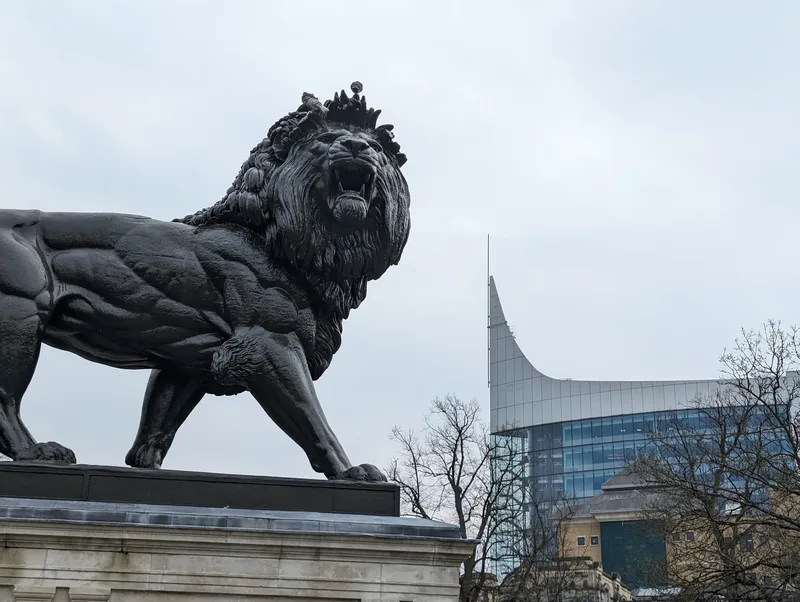
Stand at the Victoria Gates on a weekday lunchtime and Forbury Gardens looks like any well-kept English town park. Office workers from the glass blocks of the Forbury business area eat sandwiches on the benches. There may be a mother playing with her child and a gaggle of men already consuming strong lager in the shade. Roland, the head gardener edges the bedding - due to cuts he and the other gardeners sometimes pay for some of the plants themselves. Children run up the grassy flank of a curious flat-topped hill, and over everything presides a colossal iron lion, mouth open mid-roar, planted on a stone plinth as if it had just padded in from somewhere far hotter.
The ground under those lawns tells the history of our town. They have been in almost continuous public use for the best part of nine centuries. Once, it was the forecourt of one of the richest monasteries in England. It saw a royal burial procession, the execution of an abbot, the digging of Civil War gun emplacements, the din of cheese fairs and hiring fairs, and the drill of volunteers waiting for Napoleon. The Victorians turned it into a pleasure garden; the twentieth century filled it with memorials; the twenty-first has restored it, and grieved in it after an atrocity on a sunny summer day.
Few places in a modern English town carry quite so many layers so close to the surface. At only 1.8 hectares, Forbury Gardens is not large, but its history is.
A King's Abbey
The story begins in 1121, when Henry I, youngest son of William the Conqueror, founded a great abbey on the gravel spur between the Thames and the Kennet. Reading Abbey was dedicated to the Virgin and St John the Evangelist and settled by Cluniac monks from France. Henry intended it as his mausoleum, and endowed it lavishly with lands and relics, the most famous being a hand said to be that of St James the Apostle.
When Henry died in Normandy at the end of 1135, his body was carried back and buried before the high altar early the following year. For four centuries the abbey dominated the town. Its church, longer than many cathedrals, towered over Reading's rooftops, and pilgrims, merchants and royal visitors flowed through its gates. Parliaments sat here; royal marriages were celebrated here and the Forbury was open ground between two of the main gates leading from the town to the religious complex.
Like other great monasteries, Reading had a forbury. The word is Old English — roughly "the place in front of the burh", the open ground between the abbey and the borough. Reading Museum describes it as rough open land where horses grazed and pilgrims waited for services at the abbey church.
It was a meeting place as much as a threshold. The Forbury formed part of the abbey's outer court, the semi-public zone where monastic and civic life overlapped. Trade was done there, news exchanged, and crowds gathered. The Abbey Gateway, which still stands on the gardens' eastern edge, marked the boundary between this public ground and the monks' private inner precinct.
Archaeology has shown that the present gardens straddle both the inner and outer courts, and that part of the abbey nave extended under what is now the south-east corner of the park. When you walk the eastern paths, you are walking over the church itself.
1539 And All That
The abbey's end was brutal. Henry VIII's Dissolution of the Monasteries swept through England in the late 1530s, and most religious houses surrendered quietly, their monks pensioned off. Reading's abbot, Hugh Cook of Faringdon, did not go quietly. Along with the abbots of Glastonbury and Colchester, he was singled out for resisting the king's authority.
In November 1539 a gallows was raised near the west door of the abbey church, close to the gateway. Faringdon was dragged through the streets on a hurdle behind a horse and then hanged, drawn and quartered for treason, alongside two others, John Eynon and John Rugg. The Forbury, which had for centuries been where town met abbey, became the stage for the abbey's destruction.
What followed was systematic stripping. Lead from the roofs, glass from the windows and the fine dressed facing stone were carried off for reuse elsewhere. What remained were the flint-and-rubble cores of the walls — the jagged ruins that still stand east of the gardens today. The focus of Reading's commercial life drifted west, and the Forbury became an open space at the edge of town.
One echo of that November survives in stone. In 2021, to mark the abbey's 900th anniversary, Reading Borough Council invited the public to choose a new carved head for a blank block on the Abbey Gateway. Faringdon won comfortably, taking 361 of 867 votes, and his likeness, carved by stonemason Alex Wenham, now looks out over the ground where he died.
The abbey buildings did not vanish overnight. The abbot's lodging was kept as a royal residence, and in the 1560s Elizabeth I used the house and gateway as a palace on her progresses through southern England. But the Forbury itself settled into a new role: an informal commons, a fairground and a drill square.
A Hill Or Not A Hill ?
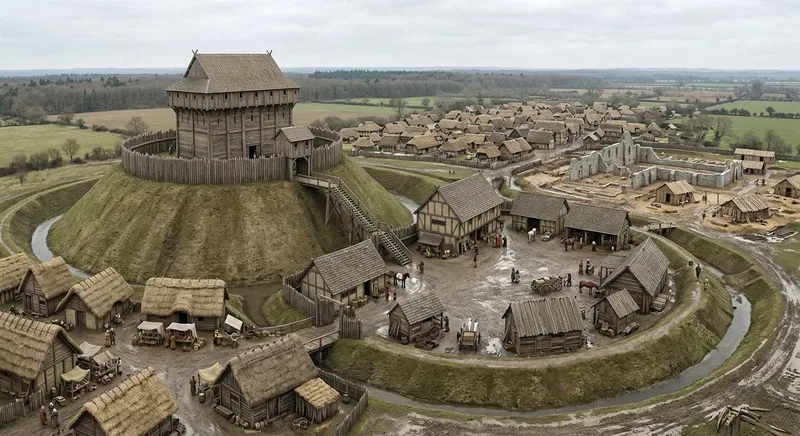
The gardens' most enigmatic feature is Forbury Hill, the flat-topped mound in the north-west corner of the old Pleasure Gardens. For generations it was said to date from 1150, when a castle was thrown up within the abbey precinct during the civil war between King Stephen and the Empress Matilda. Historic England's listing still notes that possibility, with a wooden castle built on the spot during 'The Anarchy' at 1150 and was demolished by Henry II on his acession around 1153 with no archaeological proof of its existence remaining.
What is certain is that the raised ground, with viewpoints around the town, was used as a gun emplacement in the English Civil War. Reading changed hands more than once, and during the siege of 1642–43 the Royalist garrison dug earthworks that did further damage to the abbey ruins. In 2017, however, core samples taken by the University of Reading's Round Mounds Project showed the hill could be no earlier than the 13th century. The most likely explanation is that it was raised during the Civil War itself, heaped up from abbey rubble, so the mound today likely contains some of the crumbling walls of the former abbey.
The Fairground Years
For the next two centuries the Forbury was a working public space. Three fairs a year were held there. The greatest was the Michaelmas Fair each September, which became known as the Reading Cheese Fair, although cattle, horses and hops changed hands too. It was also the district's main hiring fair, where farm workers and servants stood to be engaged for the coming year.
During the anxious decades of the French Revolution and the Napoleonic Wars, the ground doubled as a parade ground for military drills. By the early 1800s its western end was also serving as a playground for Reading School, then housed in the former Hospitium of St John. Yet the whole Forbury was privately owned, and quarrels over the town's common rights and the school's claims were frequent.
It was not a pretty place. The area was used for grazing, recreation and the dumping of rubbish and even dead animals, and in 1848 the local Board of Health condemned its disgraceful condition. After one fair, the ground was reported to be littered with oyster shells, manure and refuse. Something had to change.
The Victorians make a garden
Forbury Gardens as we know it today was born at the height of the Victorian public parks movement, when reformers argued that crowded industrial towns needed clean, ordered green space for health and moral uplift. Reading - prospering on biscuits, beer and seeds - was set to join in this enlightened movement.
Complaints about the state of the Forbury had been reaching the Local Board since July 1854. That year, Forbury Hill and the eastern portion of the present gardens were sold to the town for £1,200, of which the previous owner, a Mr Wheble, gave back £400. Local people also subscribed money towards buying the land and the abbey ruins.
In March 1855 the Borough Surveyor, J. B. Clacy, was asked to report on two competing designs submitted to the council. The Royal Berkshire Archives still hold his reports. The chosen scheme had a deliberately "botanical character", with a fountain and a summer house, and the planting of trees and shrubs was supervised by Suttons Seeds — then still a local Reading firm and one of the most famous seed houses in the world with its headquarters set to move next door to the gardens.
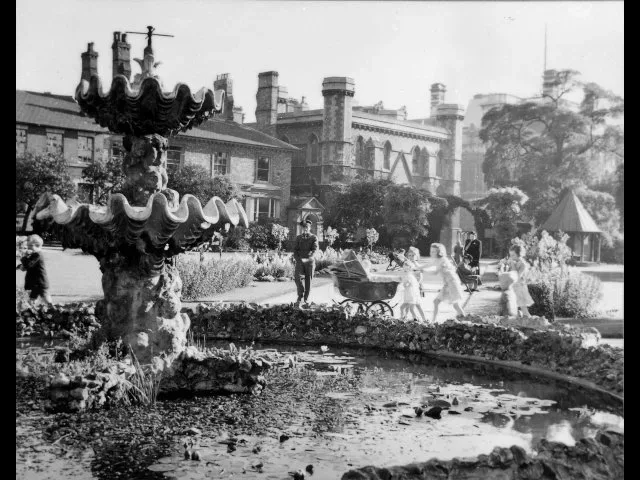
The Pleasure Gardens opened on Easter Sunday 1856. They were a genteel, enclosed space of lawns, bedding and winding walks, with Forbury Hill converted from gun platform to viewing mound. A domed alcove of flint and brick, built around 1855 and now Grade II listed, still closes the main path at the north-east corner. In 1859 a tunnel was built on the eastern side, reusing carved fragments from the abbey, to link the gardens to the ruins while carrying a path overhead towards St James' Church.
Two Halves Become One
The western Forbury, meanwhile, remained a fairground and a mess. In 1860 the town bought it from Colonel Blagrave for £6,010, and it opened as Forbury Green in August 1861. Fairs were banned, but this half stayed rougher and more utilitarian, grassed over with a gravelled parade ground, and separated from the Pleasure Gardens by a wall.
What finally unified them was, oddly, another purchase. In 1869 the town bought 12 acres of King's Meadow, the abbey's old water meadow by the Thames, as a recreation ground. With space elsewhere for games and gatherings, the western Forbury could be absorbed into the ornamental scheme. In 1873 the dividing wall came down, and the whole site became known as Forbury Gardens.
The Lion of Maiwand
The gardens' most famous resident arrived in 1886, and it came courtesy of a battlefield some four thousand miles away.
On 27 July 1880, during the Second Anglo-Afghan War, a small British and Indian brigade under Brigadier-General George Burrows met a much lager Afghan army near the village of Maiwand, west of Kandahar. In a move to be repeated more recently, the war had been launched to counter Russian influence by installing a ruler in Kabul friendly to British India. At Maiwand it went catastrophically wrong: the brigade was outflanked and broken, and the survivors fled back towards Kandahar in a desperate retreat.
Among the units engaged was the 66th (Berkshire) Regiment of Foot. The regiment's losses across the campaign were 11 officers and 318 men; the majority, 286, fell at Maiwand itself. Legend grew around a final stand by a handful of men in a walled garden, fighting to the last around their colours.
The battle also left a mark on literature. Arthur Conan Doyle made Dr John Watson a veteran of Maiwand, wounded while serving as an army surgeon - which is why Sherlock Holmes, on first meeting him in A Study in Scarlet, deduces that he has been in Afghanistan.
The memorial commission went to a Reading man. George Blackall Simonds, born in 1843 into the H & G Simonds brewing dynasty, had become a sculptor of international standing; his Falconer of 1873 still stands in New York's Central Park. For the Maiwand memorial he chose a single colossal lion, and reportedly spent long hours studying the lions at London Zoo to get it right. The design and casting took about two years.
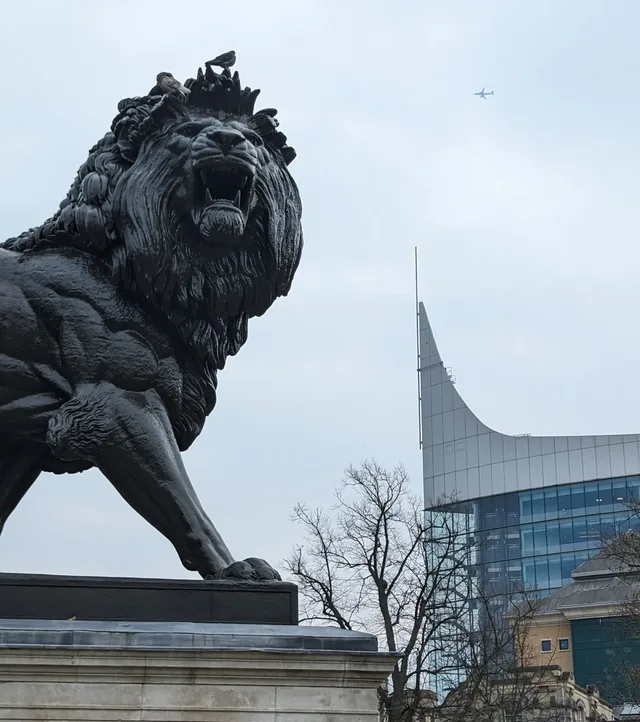
The result is enormous: around 31 feet long and roughly 16 tons, among the largest cast-metal lion sculptures in the world. It was unveiled in December 1886. The plinth carries the names of the dead, and a laurel garland ran around the top of the pedestal. The original terracotta-and-brick base cracked under the weight and was refaced in Portland stone in 1910.
No Reading story is told more often than the one about the lion's legs. The claim is that Simonds modelled its gait wrongly — walking like a domestic cat rather than a big cat — and, mortified, took his own life. But it is untrue - Simonds lived another 43 years, became chairman of the family brewery in 1910, and died at Bradfield in December 1929, aged 86.
The lion outlived both the myth and the maker. It has become the town's emblem, appearing on the badge of Reading Football Club and in the masthead of the local newspaper. Locals simply call it the Forbury Lion.
A Historic Gateway
On the gardens' eastern boundary stands the Abbey Gateway, one of only two abbey buildings, along with the hospitium, to survive the Dissolution intact, and is now Grade I listed. In the late 18th century its upper room was a classroom for the Reading Ladies' Boarding School, sometimes called the Abbey School. In 1785–86 one of its pupils was a girl of nine or ten from Steventon rectory: Jane Austen, in what was to be her last spell of formal schooling.
In 1861, in the same years the Victorians were laying out the Forbury, a thunderstorm brought part of the gateway's arch crashing down. It was rebuilt by Sir George Gilbert Scott, the leading Gothic Revival architect of the age, who also designed the nearby Reading Gaol. In 1900 the local historian and philanthropist Dr Jamieson Hurry paid for twelve new carved heads, sculpted by Andrew Ohlson. Look closely and you can still pick out survivors from the medieval building, a dragon and a fox among them, beside Victorian figures of Henry I and Queen Matilda.
Remembrance
The main entrance at the south-west, the ironwork Victoria Gates, was erected to mark Queen Victoria's Diamond Jubilee in 1897. They frame the classic view of the gardens: path, lawns and lion.
In 1909 the town finally remembered its founder. A grey stone cross in Celtic style was raised on a small mound near the north-west corner of the footings of the abbey church, commemorating Henry I. It sits a short walk from the ruins of the church in which he was buried — his exact grave now lost somewhere beneath the surrounding streets and buildings but subject to renewed investigation following the discovery of the grave of Richard III under a Leicester car park.
The tragic losses of the First World War added new memorials. In July 1919 an oak was planted between the lion and the Victoria Gates to mark the return of peace, grown from an acorn gathered on the battlefield of Verdun. Over the decades its story was forgotten, until the Woodland Trust traced it in 2016 as one of a small number of "Verdun trees" in Britain. It has since grown into a broad, handsome tree that most visitors pass without a second glance.
In 1932 the Reading Cenotaph, a stone memorial column designed by Edward Leslie Gunston, was raised just outside the Victoria Gates for the dead of Reading and Berkshire. It remains the focus of the town's Remembrance commemorations every November. Between the Maiwand Lion, the Verdun Oak and the Cenotaph, the south-western corner of the gardens has become Reading's principal place of military remembrance.
Nearly Lost In The 60s
Listing And Restoration
In 1987 the gardens were added to the National Register of Parks and Gardens at Grade II, while the ground beneath is protected as part of the scheduled abbey site. By the turn of the millennium, though, the Victorian fabric was tired. In 2004–05 Reading Borough Council carried out a year-long restoration backed by £2.13 million from the Heritage Lottery Fund.
The lion was conserved, and the bandstand, water feature, walls, railings and gateways were repaired. A new Keeper's Lodge added a kiosk, toilets and a base for a resident gardener. The gardens reopened with a celebration on 14 May 2005, and have since held a Green Flag Award as a quality green space.
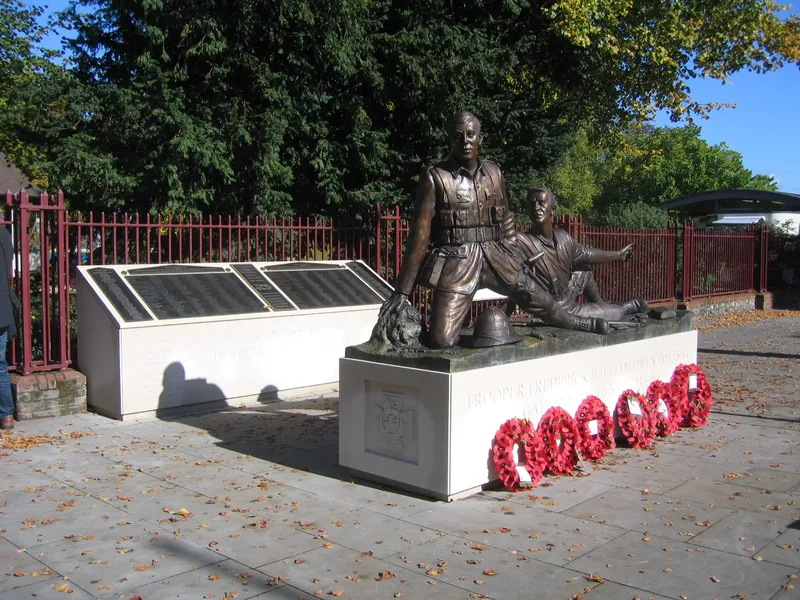
In 2015 a statue of Trooper Fred Potts, Reading's only Victoria Cross recipient, was unveiled just outside the garden wall. Potts won his VC at Gallipoli in 1915 for dragging a wounded comrade to safety on a shovel. The same year, Eric Stanford's memorial to Reading volunteers in the International Brigades of the Spanish Civil War was moved from the Civic Centre to the east side of the gardens and rededicated.
The neighbouring ruins had been closed since 2009 because of falling masonry. A £3 million conservation programme, Reading Abbey Revealed, stabilised the walls and the gateway, and the ruins reopened to the public on 16 June 2018. The tunnel of 1859 once again carries visitors straight from the lawns into the shell of Henry I's abbey, knitting garden and ruin together as the Victorians intended.
Grief And The Garden
On the warm summer evening of 20 June 2020, as lockdown eased and friends gathered on the grass, a man attacked people in the gardens with a knife. Three men were killed and three others seriously injured. It was treated as a terrorist incident, and the attacker was later sentenced to a whole-life term.
The gardens were closed for three weeks while police worked the crime scene. When they reopened, the flowers and tributes that people had left around the town were gathered and placed around the bandstand. The place that had been the scene of the attack became the place where Reading mourned.
In 2023 the bandstand was conserved and repainted in its original white and green, and the grassy slopes around its base were replaced with cobbles. Set into that cobbled surround is a memorial to the three men who died, unveiled at a service on 20 June 2023 - the third anniversary. It sits within sight of the Maiwand Lion and the Verdun Oak — the gardens' long habit of remembrance, now extended to a loss much closer to home.
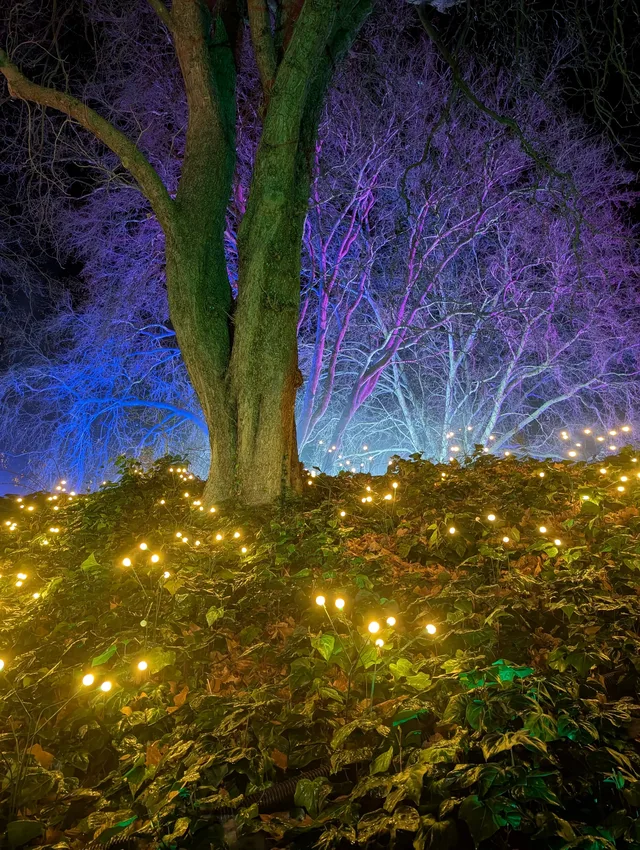
Illumination at Christmas at Forbury Gardens
The Forbury Today
Forbury Gardens is now the green heart of what Reading calls the Abbey Quarter, a cluster that takes in the ruins, the gateway, the Museum, St James' Church and the former Reading Gaol, where Oscar Wilde was imprisoned. Council-run concerts fill the bandstand on summer Sunday afternoons, and the lawns host civic and community events — among them, fittingly, a revived Reading Cheese Fair.
The planting still rewards a slow walk. Historic England's register notes an old mulberry, a tulip tree and a handkerchief tree among the specimens. Forbury Hill is reached by two gently winding, wheelchair-accessible paths to a summit about three metres up, crowned by a single plane tree and ringed with benches.
It is tempting to consider Forbury Gardens as a Victorian creation laid over older ruins. But the deeper continuity is in the name. A forbury was never meant to be private or grand; it was the open ground where an institution met the people it served. Pilgrims waited there, traders haggled, fairgoers drank, soldiers drilled and townsfolk gathered to watch — whether a royal funeral, an execution or a hiring, or simply somewhere to enjoy an ice cream on a warm day.
The Victorians tidied that ground, fenced it and filled it with flowers, but they did not change its purpose. It remains the place in front of the town: where Reading comes to eat lunch, hear a brass band, lay a wreath or stand in silence. On a quiet morning, with the lion at one end and the abbey walls at the other and you may just be able to sense your place in time, in the history of Reading.

Comments
No comments yet. Be the first to share your thoughts.
Join the conversation
Log in to leave a comment on inReading.