
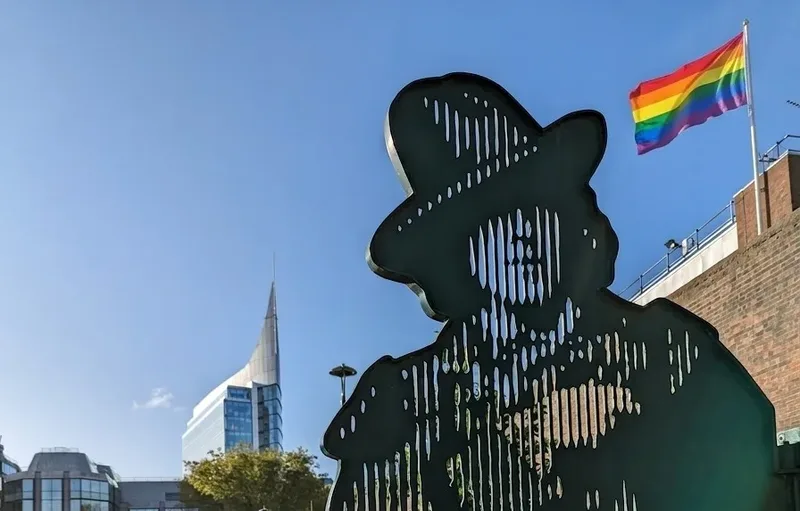
Over the centuries, the town of Reading has transformed from a site of severe state-sponsored persecution into a vibrant epicenter of modern LGBTQ+ visibility, advocacy, and cultural preservation. To understand this evolution, one must examine the physical spaces that witnessed both profound oppression and resilient community-building, tracing the path from the bleak cells of the 19th century to the open parades of the 21st century.
The defining 19th-century chapter of LGBTQ+ history in Reading centers undeniably on Reading Gaol, situated prominently on the corner of the IDR at Forbury Road. Built in the mid-19th century on the site of a former reading abbey, the prison became a grim symbol of Victorian moral policing.
The most famous inmate associated with this imposing structure was the celebrated Irish playwright Oscar Wilde. Following his high-profile conviction for gross indecency under Section 11 of the Criminal Law Amendment Act of 1885, Wilde was transferred to Reading Gaol on November 20, 1895.
Registered strictly as Prisoner C.3.3., denoting Cell 3 on the third floor of C-wing, Wilde endured an agonizing 18 months characterized by a rigid regime of hard labor, silent isolation, and psychological torment.
Despite the brutal conditions of his imprisonment, Wilde's time in Reading Gaol catalyzed a profound creative output that would influence generations of writers and social critics.
His harrowing experiences inside the prison walls directly produced two of his most enduring and haunting works. The first was De Profundis, a long, emotionally raw letter addressed to his former lover, Lord Alfred Douglas, which reflected on suffering, art, and spirituality. The second was The Ballad of Reading Gaol, published in 1898 under his prison identifier, C.3.3. This epic poem exposed the merciless realities of the Victorian penal system, particularly capital punishment and the psychological destruction wrought by isolation, bringing international attention to the inhumane conditions endured by inmates. (Ironically, it was only through the compassion of the prison governor that he had access to pens and paper at all.)
Wilde was not an isolated case in Reading Gaol - he was an unusually conspicuous one. Peter Stoneley's work on the prison's own registers found at least three young men, two labourers and a sailor, already serving sentences for buggery and "indecent acts with another male person" in 1893–94, two years before Wilde arrived in November 1895; Albert Kipping was inside for buggery during Wilde's own term, and was released early on petition, a mercy Wilde never received. The wider Berkshire record, recovered by the National Lottery–funded Broken Futures project from Reading Borough Quarter Sessions (1836–1969), the Berkshire Assizes after-trial calendars (1854–1930) and Reading Prison's admission registers and prisoner photograph albums (1889–1920), runs "from the poorest agricultural labourer to the landed gentry": two young men from Ruscombe, aged 17 and 24, charged with buggery at the 1885 Assizes and saved only by a grand jury's "No Bill"; a barman turned insurance agent who drew six weeks' hard labour in 1901 and nine months in 1913; a curate born in 1866 tried at the Autumn Assizes of November 1905; a timber dealer indicted on seventeen counts in 1918 and given twelve months. These men were charged under the same overlapping statutes as Wilde, but they left no De Profundis, and most of them survive today only as a line in a calendar of prisoners and a face in a police photograph album at the Royal Berkshire Archives.
Moving forward into the mid-to-late 20th century, the landscape of queer social life in Reading began to shift away from hidden danger toward clandestine solidarity. Before any meaningful legal reform took place, queer social existence operated through informal networks and discreet, hidden spaces. Following the partial decriminalization of male homosexuality in England and Wales via the Sexual Offences Act of 1967, dedicated social venues and early support groups began to slowly emerge from the shadows. However, decriminalization did not instantly translate into social safety or acceptance, forcing communities to rely heavily on local geography to carve out safe havens.
During the turbulent decades of the 1970s and 1980s, local venues—often discreetly tucked away near the historic town centre or along the meandering banks of the River Kennet—offered vital, safe gathering spots for gay men and lesbians seeking community. Grassroots organizing took root during this period as well. Groups such as the Berkshire Gay and Bisexual Men’s Group, alongside various autonomous women's networks, began organizing local potluck dinners, consciousness-raising circles, and informal support networks. These early pioneers laid the crucial organisational groundwork necessary for future political mobilization and community infrastructure across the Berkshire region.
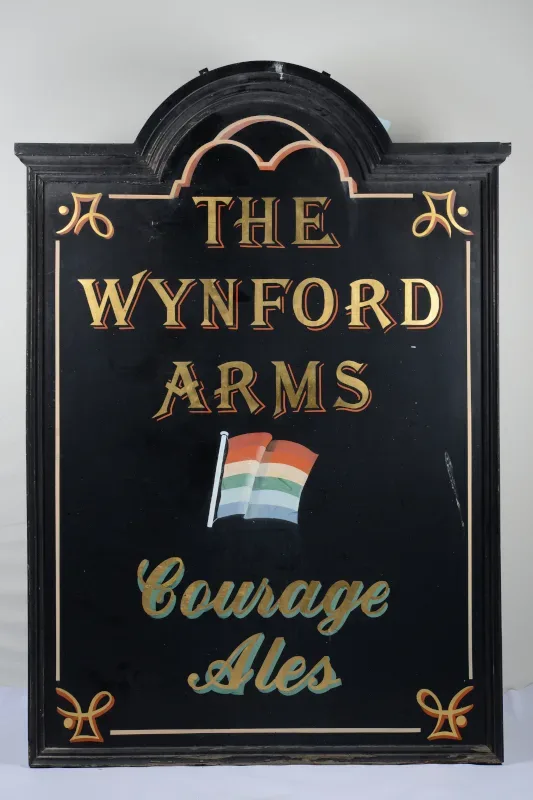
A monumental turning point for Reading's visible queer community arrived in October 1992, when landlord Simon Hallam opened The Wynford Arms on Kings Road. Affectionately known by locals as The Wynnie, this establishment became Reading's first dedicated, full-time gay pub. For over two decades, The Wynnie served as the indisputable anchor of the town's LGBTQ+ social life. It was far more than a mere drinking establishment; it functioned as a vital community center hosting charity fundraisers, political meetings, and early organisational efforts for regional Pride celebrations. Until its unfortunate closure in May 2015 and conversion by owners Heineken into 'The Thirsty Bear', The Wynford Arms provided a welcoming sanctuary for generations of local residents navigating their identities in a changing world.
The recently closed Blagrave Arms on Blagrave Street, situated conveniently near Reading station, also evolved into a major pillar of the local queer community. Maintaining an inclusive, welcoming environment, The Blagrave Arms became renowned for hosting vibrant social events, lively drag entertainment, and fostering intergenerational connections among community members. These pubs were critical lifeboats, offering spaces where queer individuals could socialize openly without fear of immediate ejection or harassment, thereby anchoring the social geography of Reading's town centre for decades.
Decriminalisation in 1967 did not close the pattern the Berkshire calendars record. Recorded homosexual offences in England and Wales stood at 5,027 in the year of the Sexual Offences Act and were still 4,781 in 1971 — and since consenting adults in private had by then been removed from the count altogether, the historian John-Pierre Joyce reads those figures not as a decline in policing but as its 'redirection'.
What eventually broke the silence in Reading was ironically not the law but the AIDS epidemic. Reading Area AIDS Support was formed in 1985, the same year an AIDS Support Group appeared in the Slough and Windsor area, running an AIDSLINE telephone helpline, a hardship fund and a volunteer "buddy" scheme; in 1986 RAAS volunteers launched Reading Body Positive with four HIV-positive clients, and in 1987 — the year the government posted Don't Die of Ignorance through every letterbox in the country — the strands were drawn together as the Thames Valley AIDS Network, which merged in 1990 to become Thames Valley Positive Support.
Reading was among the first councils in Britain to employ an HIV support officer. What started as a helpline in borrowed rooms had a lottery-funded drop-in centre by 1999 and the Queen's Award for Voluntary Service by 2013. The same decades built a public life to go with the private one: Reading Pride, founded in 2003, first filled King's Meadow on 4 September 2004 with some 6,000 people, added a parade in 2007 and drew more than 13,000 in 2022.
The dawn of the 2000s marked a decisive transition from private social circles and discreet pub culture to visible, organized public advocacy across the Thames Valley.
This era of modern activism saw the establishment of enduring institutions. Chief among these was Reading Pride, which was co-founded in 2003 by dedicated local activists including Lorna McArdle and Leslee Hopper. Driven by a desire to foster community pride and demand civic visibility, the organizing committee held its inaugural festival on September 4, 2004, at King's Meadow. Notably, it was established as one of the first completely free town-level Pride events in the entire United Kingdom, ensuring barrier-free access for everyone regardless of economic status.
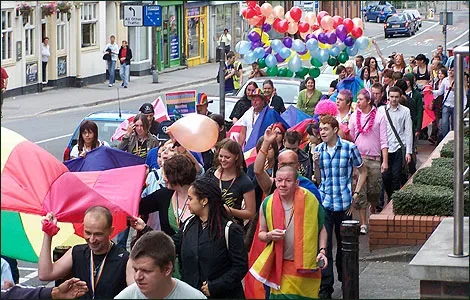
The momentum of Reading Pride continued to surge throughout its formative years. In 2007, the festival introduced a formal parade winding directly through the town centre, a milestone that significantly raised the public profile of the local LGBTQ+ community. This inaugural parade was marshaled in partnership with The Wynford Arms, cementing the deep synergy between Reading's commercial social spaces and its activist vanguards. The parade saw Reading transformed from a place of historical repression and punishment into celebratory avenues of community strength, political expression, and joyful solidarity.
As the community's needs expanded beyond annual celebrations, grassroots organizers recognized critical gaps in local health and social support services. To address this urgent need, Lorna McArdle teamed up with Andrew Stonehill-Brooks in 2010 to found Support U. This groundbreaking organisation established a dedicated Resource Centre right in the heart of Reading, designed to provide comprehensive professional services tailored to the LGBTQ+ population. Support U offered confidential counseling, specialized hate-crime reporting support, and essential sexual health guidance across the entire Berkshire region, bridging a vital gap in statutory health and welfare provision.
The organisational ecosystem continued to diversify in the mid-2010s to ensure that marginalized voices within the broader queer umbrella received dedicated attention. In 2015, activists Christina Dearlove and Kerry Kleis launched MyUmbrella LGBT+ initially as a specialized subgroup within Reading Pride. MyUmbrella was specifically created to raise awareness, provide tailored resources, and build community for lesser-represented and intersectional identities within the queer spectrum, including asexual, aromantic, genderqueer, non-binary, and transgender individuals. This initiative ensured that Reading's modern advocacy remained fiercely inclusive and responsive to the evolving language of gender and sexual diversity.
And in 2022 the town finally acquired what it had never given the men in the prison registers — somewhere to grieve: a cherry tree in Christchurch Meadows, planted as a living memorial and unveiled by Councillor Rachel Eden. When TVPS marked its fortieth year, six panels of the UK AIDS Memorial Quilt — a quilt that names 384 dead, first unveiled in Hyde Park in 1994 — hung in the University of Reading Students' Union, not so far from the gaol where the state had once done its remembering in registers.
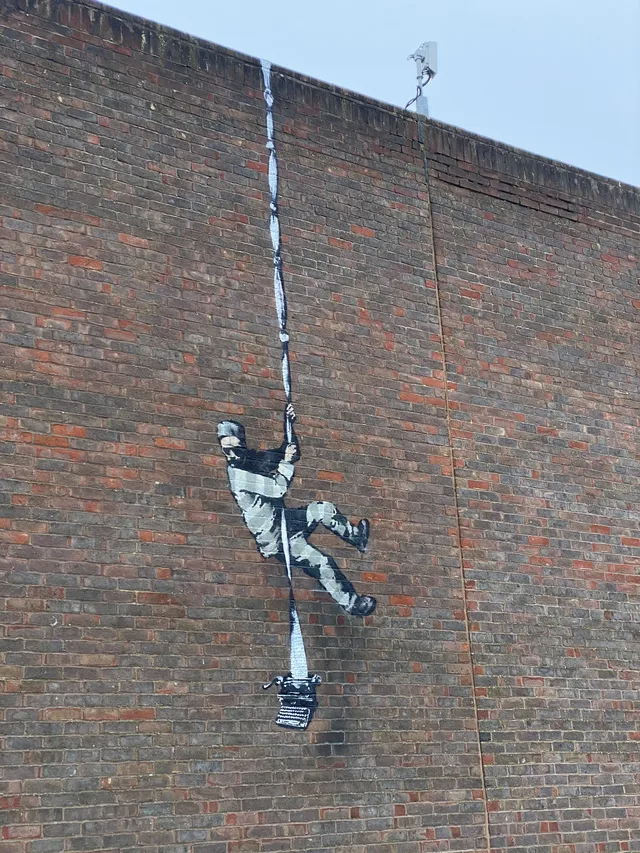
In recent years, the physical landmarks of Reading's queer history have become sites of intense public art, heritage preservation, and political campaigning. No site embodies this more than the disused Reading Gaol, which has remained a focal point for intense debate regarding its future use. In March 2021, the world-renowned street artist Banksy made international headlines when he painted a mural on the outer brick wall of the abandoned prison. Entitled Create Escape, the mural depicts a prisoner—widely interpreted as a representation of Oscar Wilde—escaping from the facility using a makeshift rope woven from bedsheets tied securely to a typewriter.
Banksy’s mural served as a brilliant visual synthesis of Reading's complex history, explicitly honoring Oscar Wilde’s enduring literary legacy while injecting massive global momentum into local campaign efforts. Activists, heritage groups, and local politicians rallied around the artwork to demand that the historic Victorian prison be transformed into a permanent arts, cultural, and heritage centre rather than being sold off for commercial development. The campaign linked the physical preservation of the prison with the honoring of its queer past, illustrating how local architecture can become a powerful canvas for historical reckoning and community aspiration, but was ultimately unsuccessful with the building still laying moribund in the hands of its new Chinese owners.
Reflecting further on the regional history of public spaces in Reading, it is vital to acknowledge the darker chapters of prejudice and violence that have also marked the town's parks and open spaces. Public parks, while functioning as vital recreational areas, have historically been sites of vulnerability for marginalized populations. Although not specifically targeted, three members of the local LGBTQ+ community were murdered in Forbury Park on 20th June 2020 by a mentally challenged asylum seeker. A memorial to them now stands in the gardens.
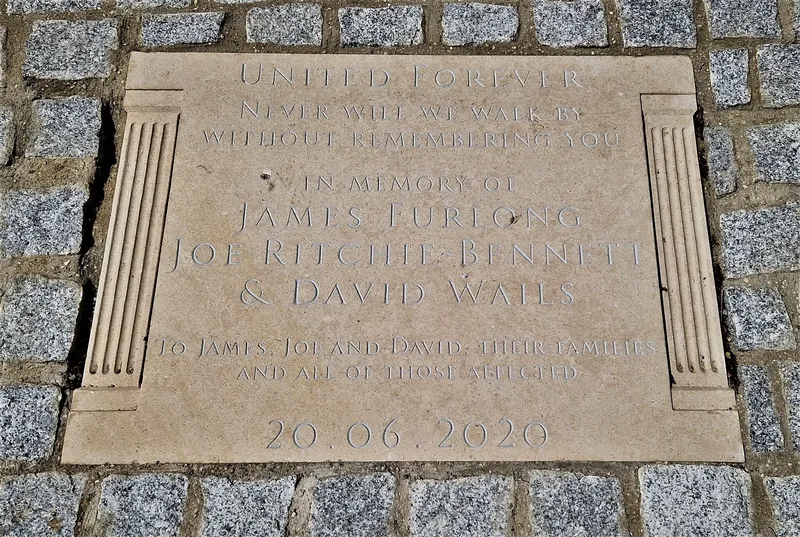
The legacy of anti-queer hostility in the region serves as a somber reminder of the dangers faced by generations of men and women who sought intimacy and community in public domains.
The history of Pride movements in Reading also mirrors the broader nationwide trajectory of LGBTQ+ rights in the United Kingdom. From the early clandestine meetings in 1970s drawing rooms and riverside spots to the establishment of permanent pubs like The Wynford Arms and The Blagrave Arms, and onward to the massive multi-thousand-strong festivals at King's Meadow managed by organisations like Support U and MyUmbrella, Reading has consistently punched above its weight in community organisation. The transition from survival to celebration required immense courage from generations of local residents who refused to be erased by oppressive legal frameworks.
Ultimately, Reading’s queer history is a testament to the resilience of grassroots organizing in the face of systemic adversity and misinformed social hostility. From the isolated suffering of Prisoner C.3.3. in his Victorian cell to the colorful, vibrant marches through the town centre, the narrative of LGBTQ+ Reading is etched into the very bricks and mortar of its local landmarks.
It's sad to conclude that now, once more, in 2026, there are new and old battles to be fought as the political rhetoric turns to mistrust and ignorance.
The 2026 Reading Pride Love Unites Parade takes place on Saturday, September 5, 2026, starting with assembly at 10:30 AM and setting off from outside Reading Station at 11:00 AM.

Comments
No comments yet. Be the first to share your thoughts.
Join the conversation
Log in to leave a comment on inReading.