
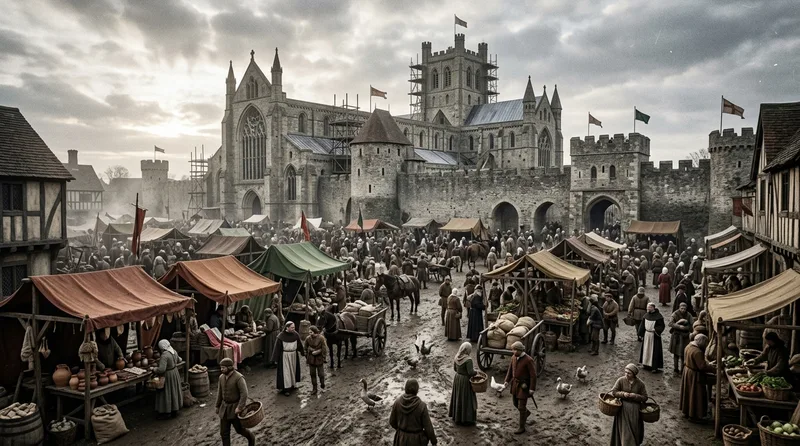
Reading sits where the River Kennet joins the Thames, on the old road between London and Bath. That location explains much of its commercial development and history. Everything that follows — the abbey, the cloth halls, the barge wars, the biscuit factory that fed Antarctic explorers, the business parks full of American software companies — is a variation on the same theme. Up until now goods and people have always had to pass through here, and residents and businesspeople of Reading have always found a way to benefit from this. But in the internet and AI era this is changing? What next for the commercial future of our town ?
The abbey that built a market
The Domesday Book, commissioned by William to audit what he had recently conquered, records Reading as a substantial royal manor and hundred containing 102 households, with mills and fisheries and a small cluster of trade. But it was ordinary. What changed to make it extraordinary was a king with a guilty conscience.
In 1121 Henry I, William the Conqueror's youngest son, founded a great monastery on high ground between the Kennet and the Thames, half way between London and Winchester, "for the salvation of my soul," as the foundation charter notes, as well as for the souls of his father, his brother and his queen. He meant to be buried there, and he was, in 1136, though the church wasn't finished until 1164. In its prime Reading Abbey was among the largest royal monasteries in Europe.
For the town, this was transformative in the most literal way. The abbey laid out new streets — Broad Street, Friar Street, London Street, names you can still walk today — and established a weekly market in front of its main gates, in what is now the Market Place. That market drew trade away from the older Saxon market at St Mary's Butts, and it drew something else besides: pilgrims. Reading Abbey held relics, including a hand said to be that of St James, and pilgrims needed beds, bread, ale, candles and souvenirs. Today, the Oracle shopping centre may be the main driver of local retail commerce, but back in the 12th century a monastery was the machine for converting piety and pilgrimage into local spending.
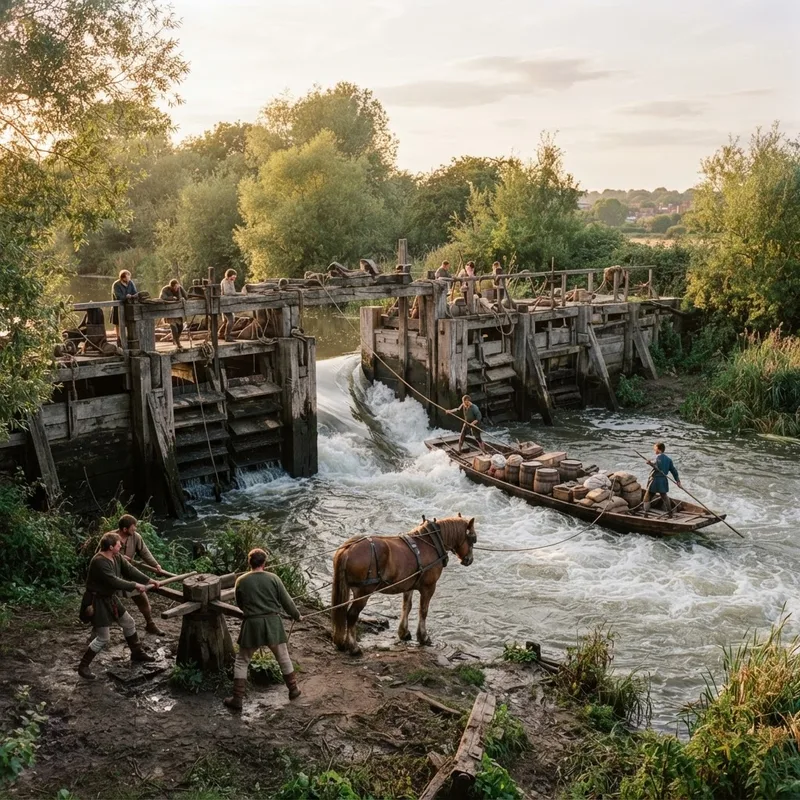
To enable trade there were flash locks on the Kennet - a primitive construction where wooden paddles and beam stakes (heathers and rimers) were manually hauled out of the riverbed to allow boats to pass through on a sudden rush of water. During the medieval period, this key point of transit was controlled by the monks of nearby Reading Abbey, who established the weir to power their mills and strictly manage river traffic. Navigating through the flash lock was both treacherous and costly, as the monks levied tolls on passing barges laden with timber, grain, and wool, turning the narrow stretch of the Kennet into a vital source of revenue for the Abbey until its dissolution.
At the time, the town's staple industries were cloth and leather. Wool from Berkshire flocks came in by boat on the rivers; it was woven, then fulled — cleaned and thickened by water-powered wooden hammers pounding it in a slurry of clay — then dyed and finished. Fullers, weavers, dyers, tailors, tanners were the businessmen of the Reading economy. There were also a striking number of vintners, because the abbey's guests drank wine and in a period of global warming the Domesday book notes a number of vineyards in the vicinity.
Prosperity bred friction. The town's merchants had their own guild, and between the twelfth and sixteenth centuries the guild and the abbey were locked in a long, grinding contest over who governed what. In 1253 the merchants won a significant round: a royal charter from Henry III, and a negotiated division of authority with the abbey. It settled nothing permanently. Disputes rumbled on for generations over the abbey's power to tax and to appoint the guild's own officers.
But the rivalry did not hold the town back - by 1525, measured by taxable wealth, Reading was the largest town in Berkshire and the tenth largest in England.
Dissolution, and a nasty surprise
Then, in 1539, the situation rapidly changed. Henry VIII dissolved the abbey. Its last abbot, Hugh Cook Faringdon, was convicted of high treason and hanged, drawn and quartered in front of his own abbey church.
The commercial consequences were immediate and painful. The pilgrims stopped coming. Shopkeepers and market traders watched their takings fall. The abbey had also been the town's largest source of poor relief, and that vanished too — a fact that would matter enormously within a century. Stones from the building were used to construct other buildings.
But the longer-term picture was more complicated, and in some ways better. With the abbey gone, merchants traded more freely. Cloth and leather survived. The corporation acquired new rights and installed itself in the abbey's old guest house, the Hospitium, as a town hall (today it is a day nursery). By Elizabeth's reign Reading was being described as the principal town of Berkshire for wealth and beauty. By 1611 its population was over 5,000, and it had grown rich on cloth.
John Kendrick's legacy
The richest Reading man of the age never really lived there as an adult. John Kendrick was born in the town in 1573, son of a clothier who served as mayor. He went to Reading School, then St John's College, Oxford, then apprenticed himself to a London master draper. He became a freeman of the Drapers' Company and made a very large fortune preparing and exporting cloth to the Netherlands.
Kendrick died at his house in Threadneedle Street on 30 December 1624, leaving something in the order of £30,000 — bequests to Reading, to Newbury, to the Drapers and to the old St Paul's. Reading's share was £7,500, to be used, in the words of his will, to set the poor at work in the clothing trade. He had seen what the dissolution had done to poor relief in his home town, and he believed employment, not alms, was the answer.
The corporation bought the Kendrick family's own textile works in Minster Street for £2,000, adapted it, and opened it in 1628 as a house of industry. Kendrick's brother William chose the name, in tribute to his late brother's vision. He called it The Oracle.
The building ran from the top of Minster Street down along the Holy Brook. It did not, in the end, revive Reading's cloth trade, and the endowment was later so badly mismanaged that it took a nineteenth-century legal battle to sort out. What remained funded two schools — Kendrick Boys' in 1875, Kendrick Girls' in 1877 — and the Kendrick name survives in Reading education to this day. A portrait of him, rescued from the workhouse, still hangs in the school hall, captioned as the founder of the workhouse.
Cannon, taxes and woolpacks
The seventeenth century did not treat Reading kindly. In 1636 it was recorded as "the prime and principal town in this county of Berkshire for fair buildings, large streets, for clothing and other blessings". Six years later the Civil War arrived.
In November 1642 Charles I entered Reading from Oxford and left a Royalist garrison behind — roughly 3,000 men, quartered on a town of about 5,000 people. The garrison demanded money, lodging and forced labour to throw up earthworks around the town. One local account has it that in places the defences were reinforced with the clothiers' woolpacks: the raw material of Reading's trade, stacked up to absorb cannonballs. Whether or not that is true, it is a perfect image of what the war did to the town's economy.
On 13 April 1643 the Earl of Essex left Windsor with a Parliamentary army of some 19,000 and laid siege. The bombardment began two days later. Sir Arthur Aston was wounded; command passed to Richard Feilding; on 25 April Feilding asked for a truce. The King and Prince Rupert arrived with a relief force the day after, too late — Feilding honoured the truce, Essex saw off the relief, and on 27 April the Royalists marched out for Oxford.
Then came the worst of it. A fever, almost certainly typhus, tore through both the besieging army and the town. Between May and August 1643 roughly 250 Reading citizens died of it — around one in twenty of the population.
The town was left with ruinous war taxation and a cloth trade that never recovered. Through the later seventeenth century, Reading's clothmaking withered; by the early eighteenth century it had ceased to be a major industry at all. Part of the problem was structural rather than martial: clothiers in the north enjoyed tax advantages that let them produce coloured cloth, while cash-starved Reading was stuck making white. For the first time since 1121, Reading had to find new ways of making money.
Malt, barges, and a mayor leading a mob
What it found was malt, and the river. Already by the eighteenth century Reading was a malting town. Barley came in from the Berkshire downs, was malted here, and went downriver to the insatiable breweries of London. Malt was bulky, low-value and heavy, which made it a water trade rather than a road trade, and that made the Kennet and Thames confluence as the town's most valuable asset.
Which explains one of the most entertaining episodes in Reading's commercial history.
From 1708, proposals came before Parliament to make the Kennet navigable from Reading up to Newbury. Hungerford backed it. So did the Wiltshire cloth towns of Westbury, Trowbridge, Bradford-on-Avon, which stood to get cheaper freight. Reading's tradesmen were violently against it, for an entirely rational reason: if goods could move straight through to Newbury, people would no longer have to come to Reading to buy and sell. Reading's whole advantage was being the head of navigation.
The Kennet Navigation Act passed anyway, in 1715. The first engineer was incompetent - the construction of ten locks were bodged at existing mill dams - and in 1718 the proprietors replaced him with John Hore of Thatcham, a maltster's son whose father happened to sit on the committee. Hore was better than his nepotistic appointment suggests. He scrapped the plan to use the river channel throughout, and instead dug artificial cuts to bypass meanders and mills. Of his 18½-mile scheme, roughly eleven miles would be new cutting, carrying twenty pound locks. His salary was £60 a year plus expenses.
In 1720, with work underway, Reading's resentment boiled over. The mayor of Reading, Robert Blake, together with the town's recorder, personally led a mob of around three hundred people out to Burghfield to sabotage the works. The chief magistrate of the borough, at the head of a riot, attacking a piece of national infrastructure because it threatened local trade.
They lost. The Kennet Navigation opened to traffic on 1 June 1723; the towpath was finished in May 1724. Total cost, £84,000 — of which the towpath alone swallowed £35,000. Barges of eighty tons and more began working meal, flour, cheese, coal, timber, iron and groceries between Reading and Newbury. Somewhat ironically, Blake's Lock, the last before the Kennet meets the Thames, was named after the protesting mayor.
Contrary to expectations, Reading did well out of the new waterway. Trade grew and when the Kennet and Avon Canal proper was completed in 1810, linking the Kennet through to Bath and Bristol, Reading found itself not at the end of a line but at the junction of a national one.
The road, the sauce, and the beer
Meanwhile the Bath Road was doing brisk business. Coaches between London and the West Country broke their journey in Reading, and the town's inns such as the Crown, the Bear, the George grew rapidly on passing trade. Coaching was an industry employing ostlers, farriers, wheelwrights, brewers, innkeepers, and a stream of hungry travellers with an hour to kill. Three of those hungry-traveller businesses turned into large enterprises.
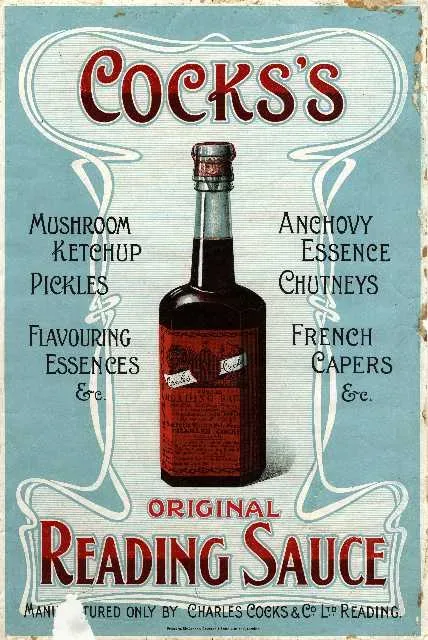
The first was a condiment that rivalled Worcestershire sauce. In 1789 James Cocks opened a fishmonger's shop in Reading, and at some point decided that he and his wife could make their own sauce to sell alongside the fish. From 1802 he marketed the recipe. Cocks's Reading Sauce, a pungent, brown concoction that became genuinely famous, and Cocks became famously litigious about it. In 1814 he sued a London oilman for passing off an imitation; the judge assembled witnesses from Dover, Taunton, Chichester and London, all of whom pronounced the London version markedly inferior. In 1842 a man named John Simmons was indicted for fraud over counterfeit Reading Sauce, and Cocks's son Charles told the court that he and his brother made it themselves and let nobody else near it — producing, as evidence, a bottle of the genuine article from his own pocket.
By the mid-nineteenth century Charles Cocks had built a factory on Kings Road, roughly where Reading's former central library now stands, and the sauce was being shipped to India. Its cultural high-water mark came in 1872, when Jules Verne sat Phileas Fogg down to breakfast at the Reform Club in Around the World in Eighty Days and gave him broiled fish with Reading Sauce. The firm lasted until 1962.
The second business was beer. William Simonds, a landed man from Arborfield, had moved into Reading in the 1760s to take up malting, and by 1774 was brewing on a small scale at the top of Broad Street. When he died in 1782 he left it to his only son. In 1785 William Blackall Simonds founded a brewery properly at 85 Broad Street — and then, within a few years, did something very ambitious. He bought a large site down by the Kennet at Seven Bridges (now Bridge Street) and commissioned the architect Sir John Soane, a local man and the designer of the Bank of England, to design his new brewery and a house to go with it. The brewery was state-of-the-art and fitted with an early Boulton & Watt steam engine.
By 1805 Simonds owned ten pubs and was supplying the Royal Military College at Sandhurst - the beginning of a long and lucrative relationship with the British Army that would eventually take Simonds beer to garrisons from Malta to India. The firm pioneered pale ale in the 1830s, including India pale ale shipped out to the army in India; developed the lighter "SB" in the 1870s; and adopted the hop leaf as its mark, rolled out across its pubs in 1930. Simonds also went into banking, founding a house that was one of the ancestors of Barclays Bank.
When William Blackall Simonds retired in 1834 the brewery passed to his sons, and it eventually incorporated in 1885 as H & G Simonds, after Henry and George. By 1938 it was producing a little over one per cent of all the beer brewed in England and Wales.
In 1960, Simonds merged with London-based brewers Courage & Barclay. Initially, the new conglomerate was named Courage, Barclay & Simonds Ltd. However, in 1970, the business simplified its corporate title to just Courage Ltd, entirely dropping the "Simonds" name from the business after nearly two centuries. The Simonds brand name continued to be used on beer labels for only a short time thereafter. Brewery at the Reading site finally ceased in 1980 and the old brewery was demolished in 1983 to make way for The Oracle shopping centre.
The birth of the biscuit town
But it is the third business that Reading was to become synonymous with for over a century and a half.
In 1822 Joseph Huntley, a Quaker, opened a bakery at 72 London Street — now number 121 — on the London-to-Bath road, more or less opposite the Crown. His son Thomas made the biscuits. His daughters served. Joseph stood at the door greeting customers, among them the writer Mary Russell Mitford. Each day, biscuits went out to the coaching inn in a basket, sold to travellers with an hour to wait.
Coach journeys are rough on baked goods. So in 1832, Joseph's younger son — also Joseph — opened a tin-making and ironmongery shop directly across the street, to supply containers that would get the biscuits home intact. That business became Huntley, Boorne & Stevens, and it turned into one of the great decorative tin manufacturers of the world.
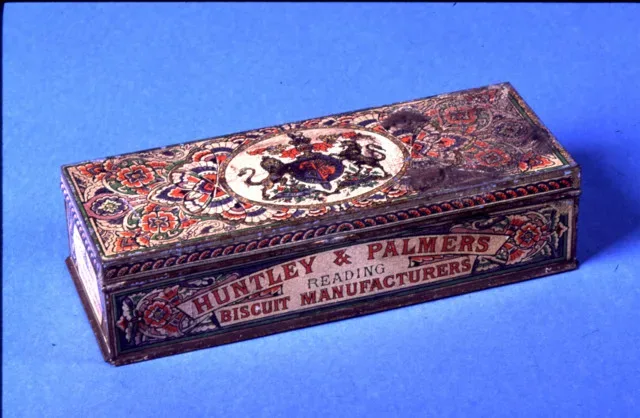
The elder Joseph retired through ill health in 1838 and handed the shop to Thomas. In 1841, Thomas took a partner: George Palmer, a distant Quaker cousin, thirty-three years old and ferociously ambitious.
Palmer's contribution was industrial. Within a year he had appointed eight agents across the country. He developed what is generally reckoned the first continuously running machine for making fancy biscuits, and in 1846 he moved production into a former silk works on Kings Road, employing forty-one men and boys. The profits tell the story: £969 in 1844–45, £7,500 by 1849–50.
Thomas Huntley died in 1857. Palmer's brothers William, Isaac and Samuel came in as partners, the Huntley interest was bought out, and the name settled as Huntley & Palmers — the Huntley kept, one suspects, because of the existing brand value.
What followed was one of the most complete industrial dominations in British history. By 1898 an industrial army of just over 5,000 men and women worked across 24 acres of factory buildings on both banks of the Kennet. It was the largest biscuit factory in the world.
By the mid-20th century, Huntley & Palmers faced intense competition and rising production costs at its sprawling, outdated King's Road factory. In 1969: Huntley & Palmers merged with rival bakers Peak Frean and Jacobs to form Associated Biscuits. In 1976 the business shut down the historic Reading factory entirely, moving all production to more modern facilities in Liverpool and London. This ended 154 years of biscuit-making in the town. In 1982 the American multinational conglomerate Nabisco acquired Associated Biscuits and in 1989 Nabisco sold its UK biscuit operations to Danone, which eventually dissolved the historic company structure.
The seedsman's son
In 1806, a corn factor and miller named John Sutton set up at 16 King Street under the name the House of Sutton. It was a modest business trading corn, flour, malt, hops, with a small sideline in farm seed.
His second son, Martin Hope Sutton, born in 1815, was one of those children who dig up the lawn to see how plants work. By six he was reportedly attempting to breed hybrid plants. He joined the business in 1832 along with his brother Alfred and immediately began arguing that the company should move into garden seed. His father told him, reasonably enough, that there was no money in it and he should pursue it as a hobby outside working hours.
Martin persisted. He opened an account with a London seed wholesaler in 1831, drew up his first balance sheet in 1832 and produced the firm's first catalogue the same year. At the end of that year his sisters made 8,700 brown paper bags for packaging. By early 1833 the seed trade was taking off. In 1836, aged twenty-one, Martin became a partner and the House of Sutton became Sutton & Son. In 1837 the business moved to the Market Place, in a prominent double-fronted shop overlooking the Saturday vegetable market, and garden seeds soon accounted for a substantial share of stock.
The seed trade of the day was notoriously crooked, often old, dead seed were mixed with fresh, or bulked out with sterilised look-alikes. In 1840 Suttons established its own laboratory to test seed for germination and purity. It was a commercial decision dressed as a scientific one, and it was brilliant: it let the firm sell on a promise that competitors couldn't match. Compulsory seed testing did not become law in Britain until the Seeds Act of 1920, eighty years later, and Suttons' station was among the first the government licensed.
The company had extensive growing plots in the alluvial fields around what is today Suttons Business Park.
Royal approval followed. In 1858 Queen Victoria asked Martin Hope Sutton to supply the royal household; the firm has held a Royal Warrant continuously since 1871.
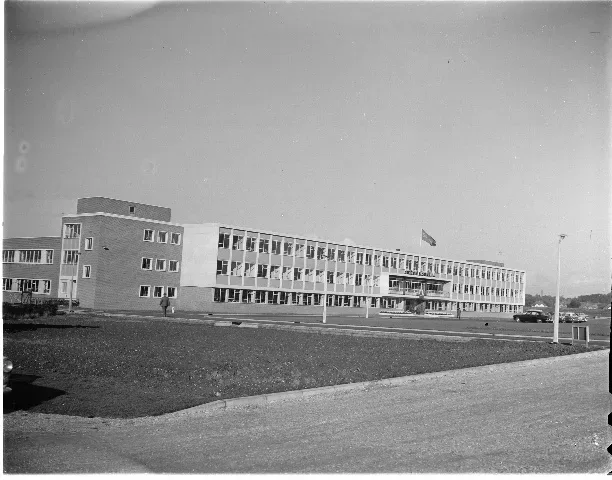
In 1962 Suttons left the cramped town centre and consolidated its offices and seed-testing facilities at its trial grounds on London Road in nearby Earley and in 1976, citing the need for better growing climates and more space, Suttons made the radical decision to leave Berkshire entirely after 170 years. The company relocated its headquarters to Torquay, Devon.
Today, Suttons Seeds continues to operate under its original name as part of the UK's largest online gardening group, BVG, which includes the Dobies garden centres. While the administrative and shipping work happens down in Devon, its historic 19th-century ledgers, seed catalogues, and corporate artifacts are preserved back home at The Museum of English Rural Life (MERL) in Reading.
The railway arrives
Reading station opened on Monday 30 March 1840, as the temporary western terminus of Brunel's Great Western Railway. The first public train to Paddington left at six in the morning behind the locomotive Firefly. The fastest recorded run took an hour and five minutes, less than a quarter of the time of the fastest stagecoach. (Six days earlier, on 24 March, a freak whirlwind struck the nearly finished station and killed a twenty-four-year-old construction worker named Henry West. His wooden grave marker still stands in St Laurence's churchyard, a few minutes' walk from the Market Place.)
The station Brunel built was an oddity — a single-sided design with both platforms south of the through tracks, meaning every up train calling at Reading had to cross the path of every down through train. It was, predictably, a nightmare, and Reading spent the next century and a half rebuilding it, most recently in a £897 million reconstruction completed in 2014.
The line reached Bristol in 1841. The Great Western Hotel opened opposite the station in 1844. The South Eastern Railway arrived in 1849 with a route to Redhill and onward connections to Brighton and, via Dover, Paris; a London and South Western service to Waterloo followed in 1856. In 1851 the GWR simply bought the Kennet and Avon Canal, the competitor it had already beaten.
For some Reading businesses this was annihilation. The long-distance coaching trade died within a few years.
For others it was rocket fuel. Suttons used the railway to bring in bulk consignments of seed and bulbs and to send mail orders out to every part of the country. The firm built a national, then an imperial, mail-order business from a shop in a Berkshire market place, shipping to New Zealand, Australia, the United States, South Africa and Japan, and eventually opening a branch in Calcutta in 1912.
Likewise, Huntley & Palmers would grow to be a major international supplier. By 1898, Huntley & Palmers’ overseas sales were so immense that they accounted for 75% of all British biscuit and cake exports. By the turn of the 20th century, Huntley & Palmers products were actively sold across 172 different countries. Their global distribution network spanned every inhabited continent, including Scott's Antarctic expedition.
Throughout recent history, the story of Reading is as a base for international commerce and it was the development of another major travel hub that has defined the reinvention of the town since the 1970s.
When the town's traditional "Three Bs" industrial economy collapsed in the 1970s and 1980s, the M4 and Heathrow’s status as a premier global aviation hub just 27 miles away helped reshape Reading.
As multinational corporations looked to establish European or UK headquarters close to Heathrow, Reading became the focal point of the M4 corridor. Instead of dealing with the high costs and congestion of central London, international tech giants favoured Reading for its direct pipeline to global markets via the airport. This catalysed the development of massive suburban business parks like Green Park and Thames Valley Park, attracting giants such as Microsoft, Oracle, Huawei, Cisco, and PepsiCo
The Broadband Years
In 1976, the Kings Road biscuit works stopped baking, Suttons had already decamped to Torquay, in the same year, having concluded that Reading could no longer supply it with enough part-time staff. Collier's brickworks had closed a decade earlier. Simonds had been swallowed by Courage in 1960, and by the end of the decade its Soane-designed brewery on Bridge Street would stop brewing altogether.
Within roughly fifteen years, Reading lost everything it was famous for.
What is striking, looking back from 2026, is how little damage this did. There was no Reading equivalent of the pit closures or the recession bedevilled steel towns. Property prices did not collapse. Unemployment did not become a defining local condition. By the mid-1980s Reading was visibly getting richer, and by the mid-1990s it was one of the most prosperous places in the country.
The reason is that the replacement had already arrived, twelve years before the last biscuit — and almost nobody had noticed.
Two men above a furniture shop
In 1964, the Digital Equipment Corporation of Maynard, Massachusetts, opened its first UK office. It consisted of two employees, on the floor above Bilbey's furniture store at 11 Castle Street, Reading.
DEC made minicomputers — machines it called Programmable Data Processors, PDPs, which were smaller, cheaper and far more versatile than the room-filling mainframes of the era. The PDP-8, launched in 1965, became the world's first mass-market minicomputer and sold more than 53,000 units. DEC's UK founder, John Leng, liked to point out that Britain had given the world the Mini and the miniskirt, so the timing for the minicomputer seemed about right.
DEC was not the only computer firm in town — International Computers Limited, the national champion assembled by Harold Wilson's government, had its software engineering department at Bridge House. But DEC grew fastest and furthest. From two people in 1964 it reached more than two thousand in Reading, and became the town's largest commercial employer. Through the 1980s, hundreds of its engineers in Reading worked on ALL-IN-1, an office automation suite that did electronic documents and email years before Microsoft Office existed; others built the networking technology that helped make the internet work.
By 1981, DEC couldn't find enough office space in town, so it built its own: DEC Park, at Worton Grange, just off junction 11 of the M4. That was Reading's first business park, and it established the template that would define the town's next forty years: big office campuses, big car parks, and a slip road onto the motorway to take a convenient flight to San Francisco or New York,
The M4 had opened in 1971. Heathrow was under half an hour away. Paddington was half an hour by train. What DEC understood in 1964, and what everyone else worked out over the following two decades, was the same thing Henry I's monks had understood in 1121: Reading is on the way to everywhere.
The business park decades
Reading's planners took DEC's idea and industrialised it.
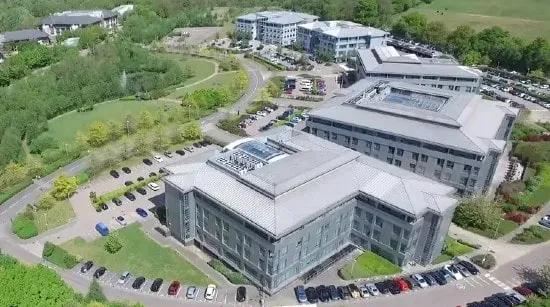
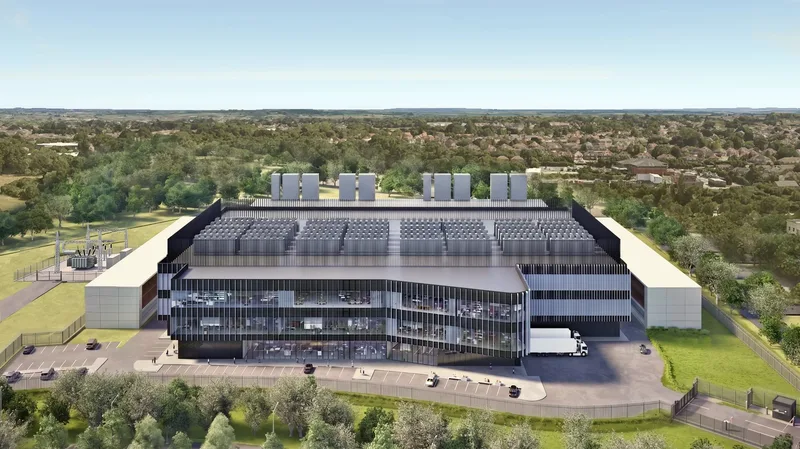
Thames Valley Park came first, breaking ground in 1988 on the regenerated site of the old Earley power station, on the Thames at the eastern edge of town and now controversially about to become a data centre. It attracted the two occupiers that would define the town's reputation: Oracle, on what is now called Oracle Parkway, and Microsoft, which built at TVP in 1994 and opened its full UK campus there in 1997. Microsoft's commitment eventually became its largest property investment outside the United States, a campus designed to house around five thousand people. Two of the largest enterprise software companies on earth, running their British operations from adjacent car parks on the edge of a Berkshire town.
Green Park followed in 1999, near junction 11 - 195 acres arranged around an artificial lake called the Longwater, eventually nineteen office buildings and about 1.5 million square feet, with somewhere north of 6,500 people working on site. Cisco was among the first international occupiers, and the cluster effect did the rest. Arlington Business Park and Winnersh Triangle filled in around them.
By the turn of the millennium Thames Valley was widely seen as Britain's Silicon Valley, the M4 corridor as the country's technology spine, and Reading as its commercial capital. It was estate-agent language, with the largest concentration of digital businesses in the UK outside London.
What the town centre did meanwhile
The Butts Centre opened in 1971 and was perhaps sensibly renamed Broad Street Mall on the western end of the high street. Broad Street itself was pedestrianised in 1995. And in 1999 Hammerson and the Abu Dhabi Investment Authority opened the Oracle, a £250 million shopping and leisure centre built on the land the Simonds brewery had vacated, taking its name from the seventeenth-century workhouse that had stood partly on the same ground. It added about a third to Reading's retail floorspace at a stroke and pulled the town decisively ahead of its regional rivals. Reading became a major retail destination.
For roughly a decade that worked beautifully. Then the internet arrived properly, and the names started going.
C&A left Friars Walk in 2004. Woolworths and Littlewoods went. BHS went. The West Street Co-op department store closed; Primark took the site, then moved into the old BHS unit. Debenhams shut its Oracle branch. House of Fraser came and struggled. And in 2013, Jacksons of Reading a 138 year old department store with handwritten receipts, polished wooden counters, and a Lamson pneumatic tube system that fired cash up to the cash office and change back down again, to the visible delight of customers who paid in notes specifically to watch it work, closed on Christmas Eve.
The response, belatedly, has been to stop pretending that the answer is more shops. The Oracle completed the first phase of a repositioning programme in 2025, reworking around 120,000 square feet and bringing in food and experience-led tenants alongside a new flagship fashion anchor; proposals exist to put several hundred flats on part of the site. Broad Street Mall won consent in 2025 for a substantial mixed-use redevelopment — homes, public space, a reduced retail core. Both schemes accept the same premise: a town of Reading's size in 2026 needs less retail floorspace and more people living in the middle of it.
The internet has not been good to Reading and the centre of town is full of empty office spaces that look unlikely to be filled. Filling retail units is becoming the same struggle as it is on any high street in the UK, or indeed, worldwide. Meanwhile the likes of Microsoft have moved to working from home and their bases in central London where more recent tech giants such as Meta and Google are based.
The COVID pandemic brought yet greater changes with a move to working from home that still manifests itself in much lower traffic volumes through the town on Mondays and Fridays in particular.
Who actually employs people now
Strip away the branding and Reading's modern economy runs on six or seven pillars.
Enterprise technology and telecoms is still the largest and most visible sector in the region, but the big-campus era that defined it is ending. At Thames Valley Park, Microsoft has already vacated two of its three buildings and will leave the third when its lease expires in December 2027, moving into the far smaller Here building next door; the landlord has applied to demolish the campus for a £200m, 72MW data centre. Oracle, having shrunk to one of its original four buildings, is hunting for 40–60,000 sq ft elsewhere in Reading, with its 24-acre site expected to come to market and the Royal Berkshire Hospital among the interested parties. Huawei, which took 140,000 sq ft at Green Park in 2013 on the back of a £1.3bn UK investment pledge, has retreated to around 30,000 sq ft at TVP since the 2020 5G ban. Three UK, at Green Park since 2021, merged with Vodafone UK in May 2025 to form VodafoneThree; Vodafone bought out CK Hutchison’s 49% for £4.3bn in July 2026, and the Green Park office is closing this year with most staff moving to Newbury.
What is replacing it is smaller, deeper and more specialised. Oxford Quantum Circuits, based at Thames Valley Science Park, raised £260m in June 2026, Europe’s largest private quantum funding round. Satcom terminal maker ALL.SPACE was bought by US defence prime York Space Systems for $355m in July 2026. NewOrbit closed an $18.5m Series A the same month for very-low-Earth-orbit satellites. Even the data-centre plans and Supermicro’s AI-driven expansion at Green Park point to the same shift: the region’s edge is no longer rent-rolls of American software giants, but compute, space and quantum hardware.
Utilities and energy are also important. The scandal hit Thames Water has its headquarters in Reading and employs roughly 8,500 people across its operating region - which makes it one of the largest single employers associated with the town, and also, given the company's well-documented financial difficulties in recent years, one of the more precarious. SSE has a significant presence but its retail business was recently acquired by OVO and it is the network business that retains a floor at Forbury in a mostly empty development that seems indicative of the woes facing commercial property in the town.
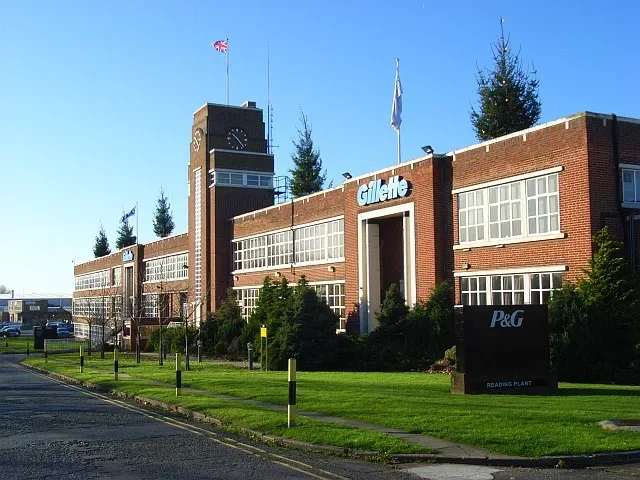
Consumer goods and pharmaceuticals are also important. Gillette has been a stalwart of Whitley since 1956–57, when it took over and completed the art deco factory on Basingstoke Road that Williamson Manufacturing had begun in the 1930s; it is the company’s European R&D base as well as a plant (the first twin-blade razor was developed there in 1964), and P&G enlarged it in 2017 to absorb its Egham innovation centre. PepsiCo’s UK head office, at Green Park since 2013, moved in early 2026 into two floors of One Station Hill beside the station - a consolidation from roughly 105,000 sq ft to 40,000. Bayer moved its UK and Ireland headquarters from Newbury to a refurbished 80,000 sq ft building at Green Park in 2016, housing its pharmaceutical and consumer health businesses and, since 2019, an AI-focused LifeHub. In 2019 Sanofi opened a new UK headquarters at Four 10, Thames Valley Park Drive — a 70,000 sq ft, £37 million facility for around 500 of its then 1,200 UK employees, consolidating offices previously in Guildford, Oxford and Maidenhead.
Professional services remains a significant employer in the town. All of the Big Four accounting firms have Reading offices. PwC, long established at Forbury Square, has been among the first tenants into the new Station Hill development. This is the quiet, unglamorous layer of a regional commercial capital: audit, tax, corporate finance, law, recruitment, servicing everyone else on this list.
The University of Reading, the Royal Berkshire Hospital and Reading Borough Council are collectively enormous employers and are frequently left out of accounts that focus on multinationals. The university in particular has become an economic actor in its own right, not just a place of study - it owns and develops the Thames Valley Science Park at Shinfield, which has turned out to be one of the most consequential pieces of land in Berkshire.
What is a more recent development has been the development of creative services in the area. In June 2024, Shinfield Studios completed construction on the university's science park: a £250 million, one-million-square-foot campus operated for the American studio platform Shadowbox Studios, with eighteen sound stages — two of them at 43,000 square feet, the largest fully climate-controlled stages in the country, thirty-eight workshops, a nine-acre backlot and over 130,000 square feet of offices. It is the largest new-build film and television studio campus in the UK. Ghostbusters: Frozen Empire was shot there while the site was still being built.
In September 2025, ground was broken on the same science park for the Natural History Museum's new collections, research and digitisation centre: a 269,100 square feet specialised storage facility, enabled by a £201 million UK government investment, designed to hold 28 million specimens - around a third of the museum's entire collection - along with molecular biology and ancient DNA laboratories. The building is due to complete in 2027 and be fully operational by 2031. Moving the specimens down from South Kensington will be one of the largest relocations of natural history material ever attempted anywhere.
That last pair is worth pausing on. For fifty years Reading's growth story was offices: sales, support, marketing and back-office functions for foreign companies. Sound stages and specimen stores are something different. They are capital-intensive, physically rooted, hard to relocate, and they generate skilled work that isn't a laptop job. It represents a new era for the town but in low employment but highly specialised sectors.
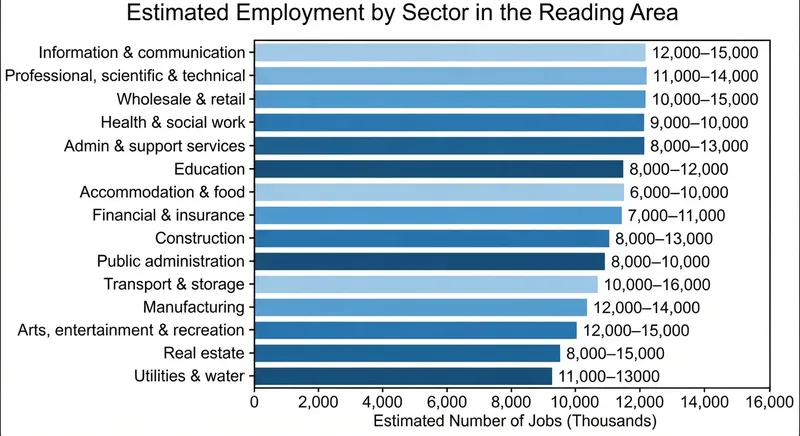
Small business is big business in Reading
Almost every account of Reading's economy is a list of multinationals, which is a distortion. The overwhelming majority of businesses in Reading, as everywhere in Britain, are small. Nationally, SMEs account for around 60% of private sector employment, and roughly nine in ten firms are micro-businesses with fewer than ten employees. Reading is not an exception; it simply has a larger-than-usual proportion of its small firms in high-value sectors.
Reading consistently ranks among the best towns in the country for SME density, and it has one of the highest concentrations of digital-sector small businesses anywhere in the UK — around one in six of its SMEs operate in digital. That is not coincidental. Big employers shed people, and the people they shed often start something. Forty years of Microsoft, Oracle, DEC and Cisco have produced a deep local pool of engineers, sysadmins, consultants and salespeople who know exactly how enterprise IT is bought and sold, and a corresponding thicket of small consultancies, managed service providers, software houses and contractors selling back into the same cluster. It is an ecosystem in the proper sense: the big organisms create the conditions for the small ones.
There is also an entire tier of local business that exists because of the office population rather than in spite of it — catering, facilities management, cleaning, security, recruitment, corporate hospitality, taxis, gyms, coffee. When 30,000 people commute into Reading every morning, somebody feeds them.
The most visible small-business revival, though, has been in food and drink, and it has an agreeable historical symmetry.
When Courage closed the Berkshire Brewery at Worton Grange in March 2010, Reading - the beer town, the town whose brewer had supplied the British Army from Malta to India - was left without a brewery of any size. It didn't stay that way. Double-Barrelled, an independent brewery in Reading with a taproom that has won national recognition, has grown from a raspberry-and-beetroot sour brewed in a garage into one of the region's better-known small producers. Phantom Brewing operates from a warehouse unit near the station, close enough to walk to. Siren Craft Brew and Loddon operate in the surrounding villages, and Siren opened a town-centre site in 2024. Reading has more breweries now than it did in 1990, just much smaller ones.
Blue Collar is the other emblematic story. It began as a street food market - traders, gazebos, a weekly pitch - and in March 2022 converted a derelict yard off Hosier Street into Blue Collar Corner: a permanent two-floor venue with four kitchens, a bar, and a rooftop, housing independent food businesses selling fried chicken, Neapolitan pizza, bao and tacos, with beer from Double-Barrelled. Six years from market stall to fixed address, on a scrap of town-centre land nobody else wanted.
And in 2021, a three-screen independent cinema, bar and community space opened in a former Argos unit in Broad Street Mall, under the name Reading Biscuit Factory. The town's defunct industrial identity has been recycled as a brand for the businesses replacing it, which is either poignant or entrepreneurial, depending on your temperament. It has gone through growing pains but has become a fondly appreciated indie centre in the middle of a town jam packed with national and international high street stores and takeaways.
The small-business picture is not uniformly rosy. Rents and business rates in a high-value commuter town are punishing for anyone whose margins are thin. Reading is not an easy place to start a business unless you have deep pockets.
And the future ?
The headline numbers are extremely good. Reading routinely appears near the very top of UK productivity rankings on GVA per hour worked - the Centre for Cities data has placed it third nationally - and it sits in the top ten for both productivity and the share of residents with high-level qualifications. That combination is not common: it is the London/Edinburgh/Cambridge bracket. For every Reading resident with no formal qualifications there are around twenty-seven who are highly qualified, a ratio that beats both Cambridge and Edinburgh.
It is also a net importer of workers, which is unusual for a town in the London commuter belt. At the morning peak, roughly 30,000 people arrive in Reading and about 24,000 leave. On the surface, Reading seems to be doing well, but there are issues.
The dot-com boom triggered a wave of speculative office development across the Thames Valley, and the oversupply has hung around for the better part of two decades. Hybrid working has made it worse. Institutional investors have been divesting regional offices; the market has shifted from passive long-lease ownership to something much more hands-on, with a lot of older stock needing either heavy refurbishment or conversion. Even Grade A spaces near the station is not letting - the old Metal Box site on Forubry has always been largely empty since being developed. And tired 1990s business-park blocks have no chance of attracting top paying corporate tenants.
Likewise, there seems to be too much of the wrong retail space. The Oracle and Broad Street Mall were both built for a shopping economy that no longer exists at that volume thanks to internet shopping, and both are being partially converted to housing whilst the centre of town, in particular, lacks low cost, low start up retail locations that are affordable and adaptable.
High productivity and high incomes come with high housing costs, and Reading has the affordability problem common to the whole Greater South East. It is a constraint on the very labour supply the economy depends on - this is a particular problem for young people wanting to work in the area. Rises in minimum wage and lack of training are issues for retail or hospitality employers as well as for trades. the internet and AI challenges the knowledge economy with location no longer being an important criterion.
Nine hundred years ago Reading grew rich on pilgrims passing an abbey. Three hundred years ago its mayor erraneuously led a mob out to Burghfield to smash a canal that threatened the town's grip on the river trade. Today locals are protesting the advent of AI driven data centres.
A hundred and fifty years ago it fed biscuits to the British Empire and sold seeds to the Queen. Fifty years ago it lost all of that and picked up minicomputers instead. In an era where location and access is no longer as important, how does Reading reinvent itself for the AI and internet era ?

Comments
No comments yet. Be the first to share your thoughts.
Join the conversation
Log in to leave a comment on inReading.