
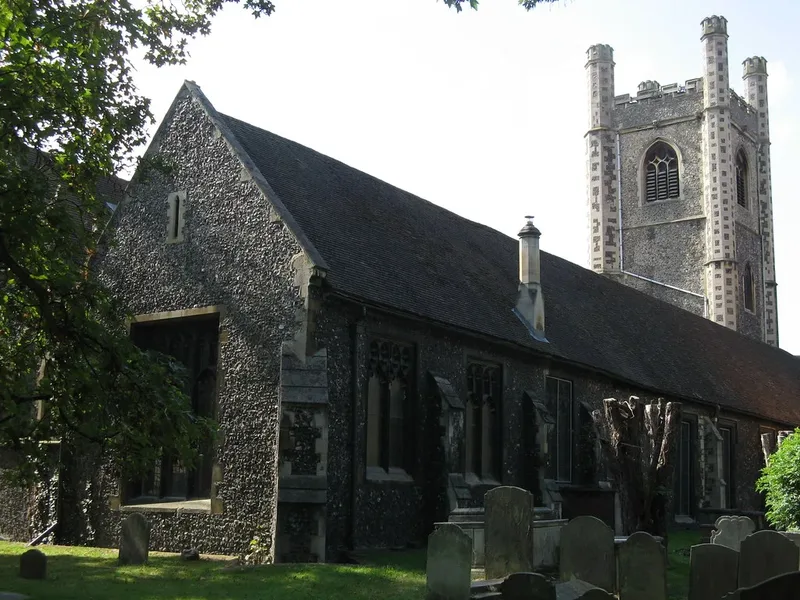
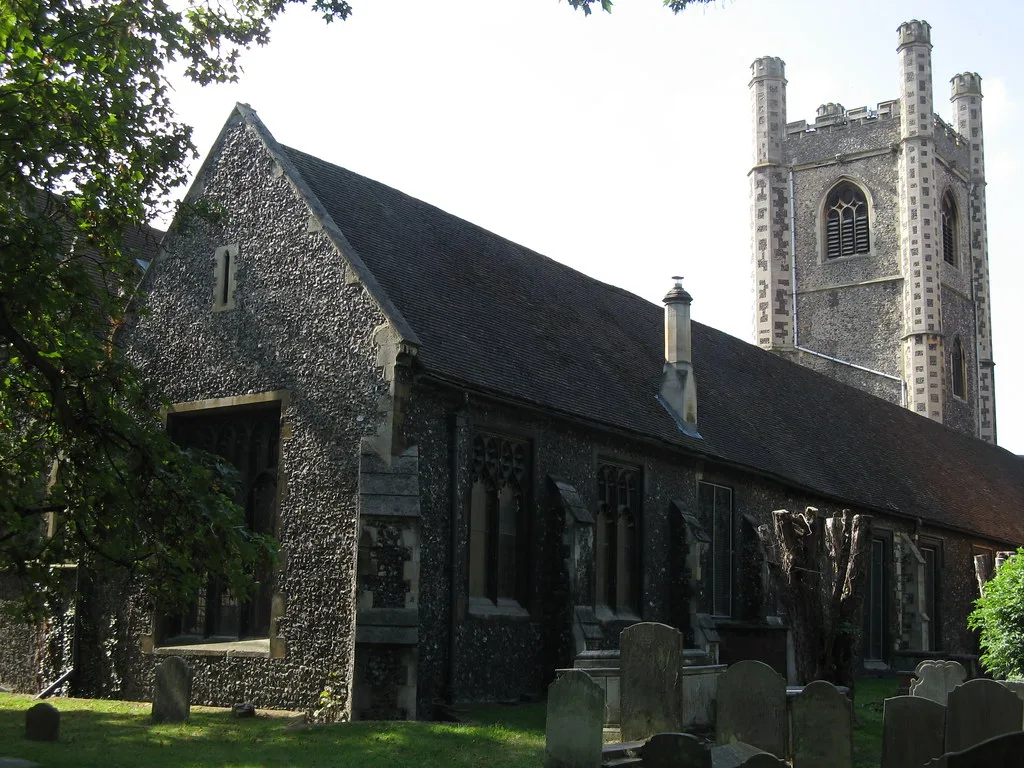
St Laurence's was one of the three original parish churches in Reading, along with St Mary's and St Giles'. When built, it was located between the main Compter Gate to Reading Abbey to the south and the Hospitium of St John to the north. A large market developed outside the church (still called Marketplace) with a pillory and stocks.
Today it stands at the end of Friar St, in between Forbury Gardens, the Town Hall and Marketplace. Behind is a small graveyard which includes a wooden memorial to poor Henry West, a workman who was blown to his death off the roof of Reading station by a freak whirlwind in March 1840. Also buried in the graveyard is John Watts, former mayor and publisher of the town's first newspaper, the Reading Mercury, in July 1723.
The church is dedicated to St Laurence, a 3rd century deacon who was martyred in Rome. He is said to have been burnt alive on a gridiron during the Valerian persecution of the church. The gridiron is consequently depicted on St Laurence's coat of arms and is included in the weather vane above the church tower.
The oldest existing part of St Laurence is the 12th century Norman tower which was built around 1120. The tower originally had a wooden spire until this was destroyed in a storm in 1624. The current stone spire was added in the 18th century. Inside the church there are a mix of architectural styles ranging from Norman to Perpendicular Gothic. The nave and chancel date from the 15th century.
Some of the stained glass windows in St Laurence are quite historic. The west window has glass from 1325 showing scenes from the Creation. Another window from the 14th century depicts the martyrdom of St Laurence. There are also monuments and memorials dating back 500 years.
The interior of the church contains several interesting items, including a memorial to John Blagrave, the 16th-century English mathematician, and a 1522 font used for the christening of Archbishop Laud. In 1619, a six-arched loggia (a covered gallery) known as Blagrave's Piazza was erected along the south wall.
On 10 February 1943 the church was damaged by a bombing raid that killed 41 people with four bombs falling during Reading’s only fatal air raid of World War Two. Most of the fatalities occurred in The People’s Pantry, a popular restaurant at 175 Friar Street opposite the church, staffed by the Women’s Voluntary Service. Michael Bond, the author of Paddington, narrowly escaped with his life. The damage can still be seen today with shrapnel marks on the front of the church.
In the 1970s, a declining congregation meant that the parish of St Laurence was merged with that of St Mary's, and at the end of the 20th century it was decided to seek a new role for the church. The interior of the church was remodelled, with a modern mezzanine floor inserted to one side of the nave. Today it serves as a mission church with a mandate to encourage faith amongst younger people.
Some of the above content was sourced from Wikipedia.

Comments
No comments yet. Be the first to share your thoughts.
Join the conversation
Log in to leave a comment on inReading.