
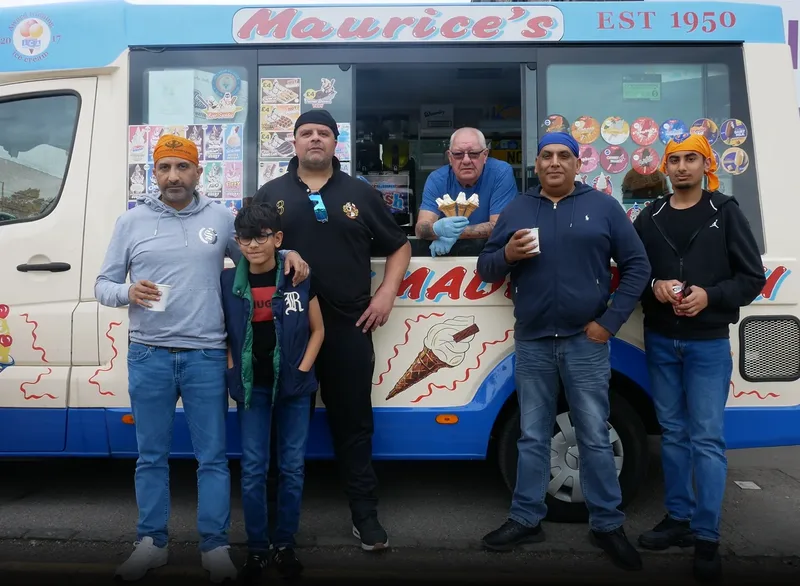


This summer has seen the re-appearance of ethnic issues across parts of the UK, but Reading remained calm, perhaps due to its long tradition of immigration, from the influx of Irish labourers in the 19th century to the arrival of Caribbean immigrants after World War II, and the diverse waves of newcomers from across the globe since, with a significant number of Hong Kong and other Chinese people being the most recent incomers.
 Source: 2021 census, ONS
The story of immigration in Reading goes back well over a century, making up our current diverse community that is nearly half non-British white by now.
Of course, from the immigrants who first crossed the land bridge to the British Isles through the Romans, Saxons, Vikings and Normans if any local resident were to take a DNA test they might find how diverse the population was and is.
The more recent story of immigration starts close to home, with the significant Irish presence that began in the early 19th century, starting with the 'navies' or navigators, who were recruited to dig the canals criss crossing England during the early 19th century. Like many other parts of England and beyond, Reading experienced a surge in its Irish population during the Great Famine of the 1840s. The town’s industrial growth—fuelled by its location on the railway line between London and the West Country—created a demand for labour that Irish immigrants filled - a story that has often been repeated. The Irish immigrants were instrumental in building much of the town's infrastructure, including buildings, roads, railways, and canals. Many settled in areas with affordable housing, such as Katesgrove and Newtown.
By the late 19th century, Irish Catholics had established the Pugin designed St James’ church near Forbury Gardens, St Joseph’s school on Upper Redlands Road, the Hibernian Society and the Irish Centre in Chatham St and Gaelic sports sides, all of which still exist today - you can see the Gaelic football posts in King's Meadows - although the current Irish population is more likely to work in tech or at the Royal Berkshire Hospital.
The end of World War II marked the beginning of another significant chapter in Reading’s immigration history. The British government, grappling with labour shortages, invited citizens from the Commonwealth to help rebuild the nation. Among the first to arrive were Barbadians (or Bajans), part of the wider Windrush Generation named after the HMT Empire Windrush, which brought hundreds of Caribbean migrants to the UK in 1948.
For many Barbadians, Reading was an attractive destination due to its thriving industries – many worked on the buses in the town and, in a trend that persists to this day, took up menial jobs.
 Randolph Bancroft from Barbados is one of many immigrants who have opened successful businesses in Reading
The Barbadian community quickly established itself, with families settling in areas like Newtown and Oxford Road. The influence of these immigrants is still evident today, particularly in the town’s cultural life. The annual Reading Carnival, for example, draws heavily on Caribbean traditions, celebrating the music, dance, and food of the region. The town also boasts a number of Caribbean restaurants, with Dolphin’s due to open in St Mary’s Butts at the end of the year. The community even has its own publication RCE News.
Over time, the Barbadian community expanded to include other Caribbean immigrants, especially from Jamaica, and these groups played a crucial role in diversifying Reading’s cultural and ethnic landscape.
The late 20th and early 21st centuries have brought new waves of immigrants to Reading, reflecting broader patterns of globalisation and economic change. Following the expansion of the European Union in 2004, a significant number of Eastern Europeans, particularly Poles, settled in Reading. There are Polish shops and a pub, as well as a Ukrainian Centre. Drawn by employment opportunities in construction, retail, and the service industry, these immigrants added yet another layer to the town’s multicultural identity.
 Reading's Ukrainian community taking part in Waterfest
Reading has also clearly seen an increase in immigrants from South Asia, particularly from Nepal, India and Pakistan, as well as from Africa, the Middle East, and East Asia. These groups have enriched the town’s cultural offerings, introducing new cuisines, festivals, and traditions. The annual Diwali celebrations, for instance, have become a fixture in the town’s calendar, reflecting the growing influence of the South Asian community.
Most public bodies publish their documentation at least partially in diverse languages to cater for those whose first language is not English. But the reality is that the vast majority of residents quickly become fluent through work or education. However, the language profile does belie some of Reading's less known communities, such as the Portuguese speaking Brazilian people living and working in the area.
 Source: 2021 census, ONS
A notable community in Reading is the Nepalese population, many of whom are ex-servicemen and their families. The Gurkhas have a long tradition of serving in the British Army going back over two centuries. The headquarters of the Brigade of Gurkhas is at nearby Sandhurst and the Brigade moved its base to Aldershot in 1997, when Hong Kong, its previous home, was handed back to China. In 2009, it was made law that all those Gurkhas who had served for four years or more in the British Army before 1997 had the right to settle in Britain, following a high profile campaign led by the actress Joanna Lumley. Many chose to settle in Reading and have opened restaurants and shops and made the delicious momo dumplings practically a local dish.
Some of the immigration has been based on the establishment of international businesses in the town. Vodafone saw new German residents and Huawei Chinese. The many tech companies saw influxes from North America and from India. But the reality is that for many, Reading is a place they live whilst they study and work and often move on. If anything defines Reading, it is the mobility of labour.
(There is a marked difference between the town’s Indian and other South Asian populations in that India does not allow for full dual nationality, whereas countries like Pakistan and Bangladesh do, resulting in more permanent and expanding populations from other countries in the subcontinent.)
A study, again from the ONS, of where Reading residents were born makes for fascinating browsing:
England 111815
India 7762
Poland 4948
Other Southern Asia (inc Nepal and Sri Lanka) 4224
Pakistan 3546
Romania 3231
Other EU countries 2786
Other Europe on EU 2349
Wales 1821
Scotland 1659
Other EU 1574
Italy 1466
Ghana 1439
All South American countries 1365
Hong Kong (Special Administrative Region of China) 1330
Ireland 1313
China 1269
Other South and Eastern Africa 1212
Portugal (including Madeira and the Azores) 1105
Spain (including Canary Islands) 1099
South Africa 1067
Other Caribbean 1041
Nigeria 954
Other Middle East 954
Other Central and Western Africa 935
North Africa 932
Germany 897
Philippines 759
France 758
Zimbabwe 758
United States 678
Other South-East Asia 649
Kenya 613
Turkey 606
Northern Ireland 587
Bangladesh 521
Sri Lanka 497
Lithuania 460
Jamaica 426
Australia 365
Malaysia 329
Iran 328
Other Eastern Asia 286
Canada 268
Afghanistan 246
New Zealand 198
Somalia 159
Singapore 143
Central Asia 126
Central American countries 113
Iraq 112
Croatia 81
Other Oceania and Antarctica 26
Other Africa 12
United Kingdom not otherwise specified 11
Other North America 11
Great Britain not otherwise specified 1
Other Australasia 1
The rise of misinformation and the far right using online platforms such as X/Twitter have clearly increased tensions and there has sadly been a marked rise, for example, in suspensions for racial abuse within local schools, but perhaps because of its historical diversity Reading has not suffered as much as other conurbations in the UK from ethnic strife. Of course, there remain worrying incidents of racism and hate crimes, but overall the story is one of harmonious integration and a town where people from all kinds of backgrounds and beliefs respect each other and even enjoy the diversity of cultures that enrich our overall community. Long may it continue.

Comments
No comments yet. Be the first to share your thoughts.
Join the conversation
Log in to leave a comment on inReading.