
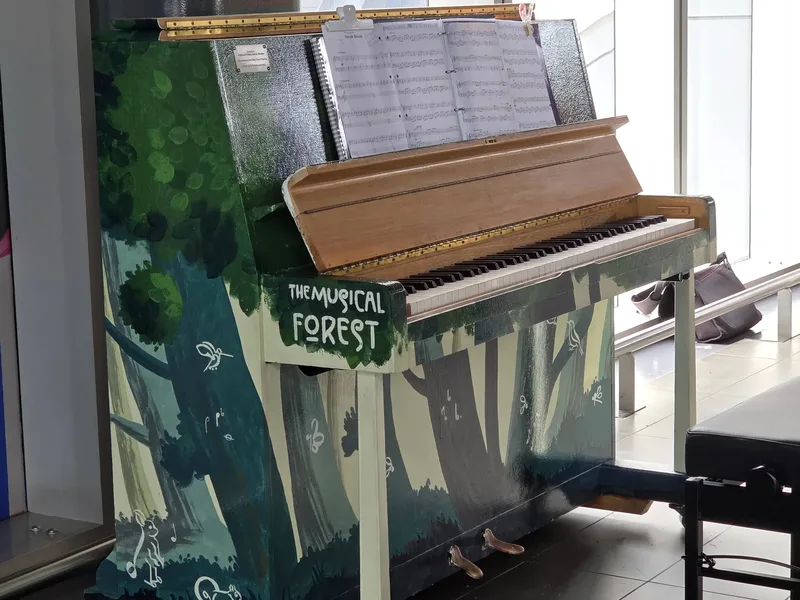
The Musical Forest is now enchanting commuters visiting Reading station – but what is it and how can you get involved?
The most unusual jukebox has been installed in Reading’s railway station … It’s powered by humans, and commuters will never know what they can expect to hear as they rush to catch their trains.
A street piano has been installed on the main station concourse giving people an opportunity to play while they wait for their connections. The choice of tunes will entirely be up to them, meaning people will rarely hear the same thing twice.
The musical instrument has been donated through Reading teamwork.
Highwood Primary School in Woodley donated the piano to the Reading Library of Things, who worked in partnership with Reading Rotary Club to restore it. When they had completed reworking the keys, pedals and woodwork, they tasked Reading street artist Commando Jugendstil to decorate it.
The result is called The Musical Forest, and it is enchanting.
It was unveiled at a short ceremony held at Reading Station on Thursday, April 24.
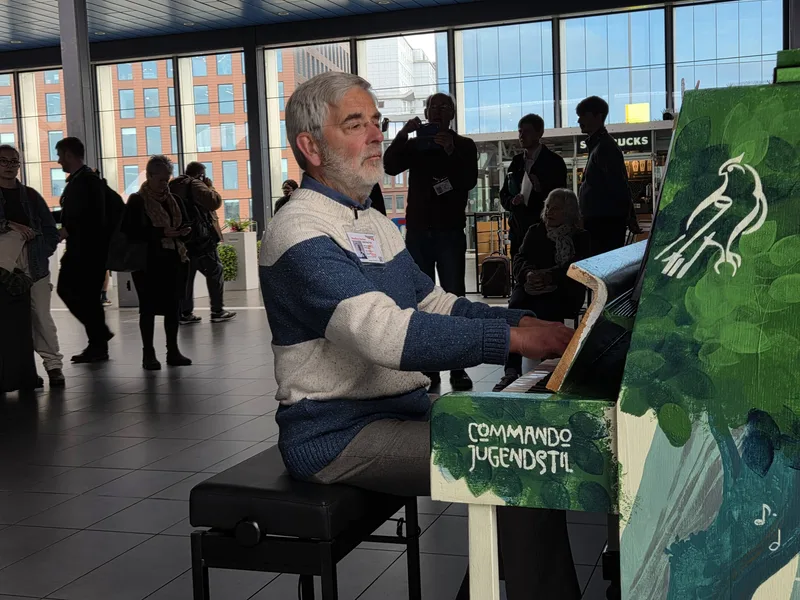
The Rotary Club’s Bob Castellan played the inaugural tunes and immediately attracted a crowd of delighted travellers, some of whom instantly whipped out their phones to record the music to share with friends and family.
Where did Street Pianos come from?
Believe it or not, the idea of a Street Piano – one that anyone can rock up and play rock on (or jazz, or classical, or any other genre) – is a relatively new concept.
While for years many pubs and clubs had their own for communal singalongs, the idea of putting the large instrument in public places is a 21st century initiative. The first was set up in Sheffield in 2003, with a simple sign next to it saying ‘play me’.
Five years later artist Luke Jerram curated an installation of street pianos across the country. A decade on, that small collection had become more than 1,900 pianos in 70 cities worldwide, turning a pop-up idea into part of the cultural fabric of travellers.
The idea has taken off and led to a hit Channel 4 series called The Piano. Hosted by Claudia Winkleman, it launched in 2023, and sees amateur musicians invited to perform on Street Pianos. Winners were selected to perform in an end-of-series concert at the Royal Festival Hall.
The latest search for a star is currently airing on Channel 4, with the winner to be revealed by the end of May.
Reading’s railway station is managed by Network Rail and they have been enthusiastic champions of the plans to install a Street Piano in Reading station, which celebrated its 185th anniversary in March.
It first opened its doors to the public in 1840 as a temporary terminus for Brunel’s Great Western Railway while engineers continued building the line to Bristol.
The site has changed a lot since then, with the Three Guineas pub a conversion of the old ticket office and waiting rooms. Ten years ago, the latest redevelopment was completed, extending the station so that Elizabeth Line trains could terminate here, and creating a massive concourse that goes over the tracks.
It is here that the Street Piano has been placed: next to the Starbucks and not far from the top of the escalators from the town centre entrance. The sound musicians will create will resonate across the building and give those heading to their platforms a musical welcome.
Bernadette Sachse, the station manager, says Network Rail had been fortunate to have the Reading Rotary Club donate the piano as they were in deep need of one.
“We used to have one but unfortunately it was beyond repair and we thought our piano days in the station were over,” she explains. “Luckily, the Rotary Club made a very kind offer of a fully refurbished piano, perfect for our needs so we jumped at the chance.
“People love to have the piano in the station. You will see people from all different walks of life, passengers travelling through, colleagues who work here, or those with just a few minutes to spare tinkling along while they are waiting or have some spare time.
“It really gives some joy back to the passengers; it lights the station up and it enhances the atmosphere.” So, will Bernadette be one of the people playing? She laughs. “I don’t play myself, but I feel I probably need to learn a few things at home and then come and surprise my colleagues.”
Street Piano is a happy gift from Reading to Reading
Tony Cowling, who is a member of Reading Rotary Club and Reading Library of Things, says the launch event was a very happy occasion, and he is delighted that two of the many initiatives he is involved in have come together in this way.

“The piano was donated to the Reading Library of Things,” he explains. “I help them and they don’t take musical instruments so I shipped it on to the Rotary Club. We renovated it, tuned it, cleaned it up, had a mural painted on it, gave it new castors and facilitated getting it to the station.
“And it’s wonderful; it’s a happy, happy event.
“Bob is a member of the Rotary Club and a pianist and he has been playing, but the idea is that members of the public can come and have a tinkle, and people can stand around and listen.
“It’s a nice thing to have and I’m loving it today.”
He also praised Commando Jugendstil for donating his time to create the artwork that adorns the piano: The Musical Forest features trees, musical notes, animals, and birds. With plenty to look at, even if the piano is not being played it is an attraction.

“Commando Jugendstil created the mural of Reading Hydro, which is where I met him. He has also created art at Holy Brook Nook and Reading’s Market Place,” Tony says. “And there is more in the pipeline.
“It is great to have this art on the piano, it is simple and impactful and we’re loving that as well.”
Who are the Reading Rotary Club and how do you contact them?
Founded in 1922, the Rotary Club of Reading is one of five clubs in the greater Reading area and has around 40 members.
Meeting regularly for friendship, inspiration, and support, they organise several projects and events across the town with an aim of supporting good causes, both in Reading and across the world.
Among its biggest events is the Santa Run which takes place in early December on the Whiteknights Campus of the University of Reading,
The group welcomes new members.
For more details, log on to: https://www.readingrotary.co.uk/
What is the Reading Library of Things and how can you get involved?
The Reading Library of Things is like a traditional library except that instead of lending books it lends a range of items including tools, specialist equipment, trailers, and electronics.
The idea is to pool resources especially for tools and devices that are rarely needed. For example, people may need a tile cutter if they are redecorating their bathroom, but this is something they will do once every 15 years or so. By letting people borrow what they need, it saves having to buy and store specialist equipment while also ensuring people have the right tool for the job.
Among the inventory is a percussion hammer drill, a pressure washer, a data projector, a sewing machine, pint glasses, bike racks, chisels, a can crusher, and an oscilloscope.
There are no fees for borrowing, unless the item is returned late. To take something out of the library, people have to join and membership is £25 per year – it’s free for the first year if you have something that can be donated for use.
The Reading Library of Things also welcomes volunteers to help maintain the service.
For more details, to join or to see the inventory, log on to: https://lotreading.myturn.com/


Comments
No comments yet. Be the first to share your thoughts.
Join the conversation
Log in to leave a comment on inReading.