
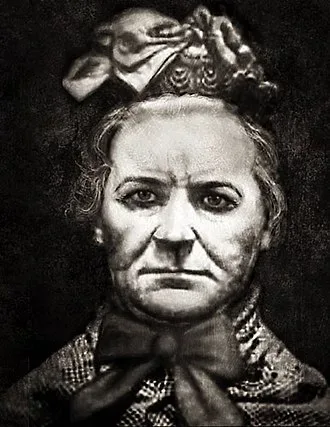
The history of Victorian Britain is often romanticized through the lens of industrial progress, literary achievements, and sweeping imperial expansion. But beneath the veneer of Victorian respectability and societal advancement lay a dark and desperate underbelly, born from grinding poverty, a rigid moral code regarding illegitimacy and a glaring lack of social safety nets for the most vulnerable.
Among the most harrowing manifestations of this grim reality was the practice of 'baby farming' - a corrupt commercial enterprise where individuals took in unwanted infants in exchange for a lump-sum payment or meager weekly allowance, ostensibly to care for them or arrange for their adoption. In far too many instances, however, this practice served as a legalized death sentence for innocent children. The dark history of nineteenth-century child exploitation and institutional failure is epitomized by the chilling case of Amelia Dwyer, a woman whose horrific actions in Reading left an indelible stain on the local community and exposed the terrifying vulnerabilities of the era's most defenceless residents.
To fully understand the world in which Amelia Dwyer operated, we have to look at the social and economic pressures that drove desperate mothers to her doorstep. In Victorian England, unwed mothers faced catastrophic social ruin. An illegitimate pregnancy meant immediate dismissal from domestic service, ostracisation from family, and virtually no legal recourse for financial support from the father. Destitute and terrified of public shame, these young women found themselves with vanishingly few options. More common still in an era of no contraception were mothers who kept on having children their families simply could not afford. Backstreet abortions and child mortality were rife.
Into this vacuum stepped the 'baby farmers', preying upon the desperation of these women. People like Amelia Dwyer advertised their services discreetly through newspapers or word of mouth, presenting themselves as compassionate caretakers offering a fresh start for infants whose very existence threatened to destroy their mothers' lives. For a fee, which was often impossibly high for a working-class woman to raise, the baby farmer promised to provide food, lodging, and a loving adoptive home. In reality, the transaction was frequently an exchange for the child's life, as people like Dyer realized that dead babies consumed no resources and required no future care.
At the time, Reading was a bustling commercial hub, growing rapidly during the latter half of the nineteenth century. Yet, like many industrializing towns, it housed significant pockets of deep poverty alongside its growing prosperity. Young people from the surrounding area were thrown together in the new factories, breweries, shops and offices of the burgeoning urban area and the result was many unwanted pregnancies.
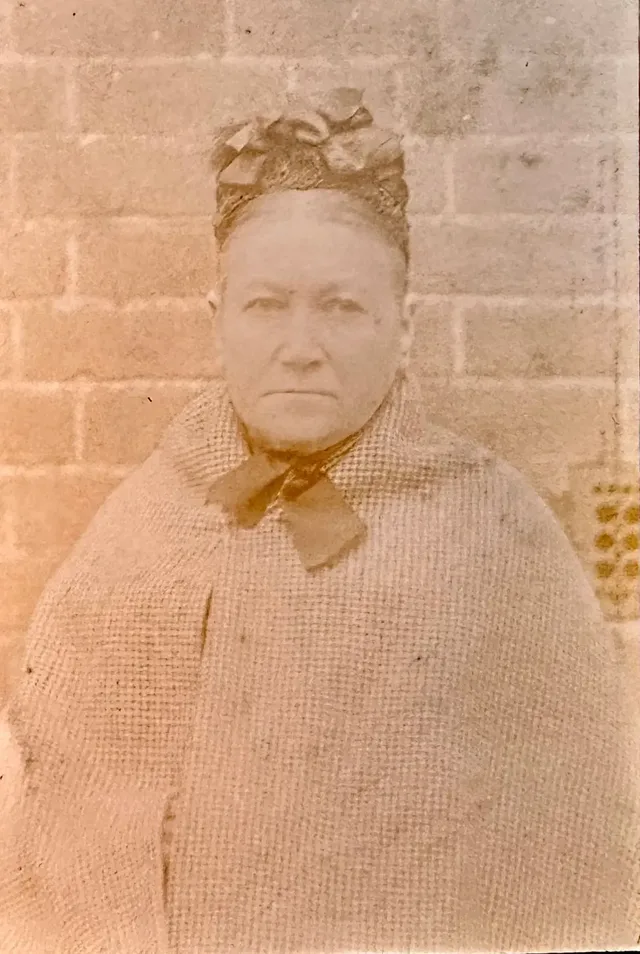
It was against this backdrop that Amelia Dyer established her grim operations. Operating out of unassuming domestic dwellings, Dyer managed to project a veneer of normalcy that shielded her from immediate suspicion by neighbors and local authorities. The mechanics of her enterprise relied heavily on secrecy and the transient nature of the desperate mothers who utilised her services. Most clients were young, frightened, and eager to distance themselves from the circumstances of the birth, meaning they rarely returned to check on the welfare of their offspring once the initial payment was handed over. This lack of oversight created a dangerous vacuum, allowing Dyer to operate with virtual impunity for a troubling duration before the horrific truth of her practices finally came to light.
Amelia Elizabeth Hobley was born on November 27, 1837, in Pyle Marsh, a small village just east of Bristol. She was the fifth of six children born to Samuel Hobley, a skilled shoemaker, and Sarah Hobley. Unlike many of her peers, Amelia was reasonably well educated, developing a love for poetry and literature. However, her childhood was severely disrupted by domestic tragedy.
Her mother contracted typhus, which left her with severe mental illness and violent fits. Young Amelia was tasked with caring for her mother until Sarah's death in 1848. Some historians have often noted that witnessing her mother's mental decline taught Amelia how to recognize and simulate symptoms of mental illness - a skill she would later leverage to evade criminal prosecution.
After her mother died, Amelia lived with an aunt in Bristol and served an apprenticeship as a corsetmaker. Following her father's death in 1859, she became estranged from her family and, in 1861, married George Thomas, a much older 59-year-old man. To narrow their 32-year age gap on the official record, George deducted eleven years from his age while Amelia added six.
Shortly after her marriage, Amelia trained as a nurse, a profession that introduced her to midwife Ellen Dane. It was from Dane that Amelia learned of a lucrative, low-risk business model based on her training: taking in unwed mothers and facilitating the "adoption" of their illegitimate children for a fee.
When George Thomas died in 1869, Amelia was left without an income to support herself and her daughter, Ellen (Polly). She turned to baby farming full-time, placing advertisements in local newspapers claiming to be a respectable, married woman eager to offer a loving home to a child.
Initially, Dyer allowed the infants in her care to die through deliberate neglect, starvation, and sedation. She routinely administered "Godfrey’s Cordial", a popular, unregulated syrup containing laudanum and alcohol known colloquially as "Mother's Friend" to quiet crying babies until they starved to death.
In 1879, Dyer’s operations hit an obstacle. A suspicious physician noticed that an unusually high number of infants under Dyer's care were dying, and he refused to continue issuing death certificates without reporting his concerns.
Dyer was arrested, but rather than being tried for murder or manslaughter, she was convicted only of child neglect. She was sentenced to six months of hard labor in Redisdale House. The experience broke her physically and mentally, prompting a change in the way she went about her 'business' upon release.
To avoid future suspicion from medical professionals, Dyer decided to bypass doctors entirely. Instead of letting infants waste away over several weeks, she began directly strangling them immediately upon receipt, disposing of the corpses herself.
Whenever law enforcement or inquiring parents grew too close, Dyer would feign mental breakdowns and check herself into lunatic asylums. Having worked as an asylum nurse, she knew precisely how to behave to secure committal. Between periods of criminal activity, she spent time in several institutions, including the Somerset and Bath Lunatic Asylum. These stays served a dual purpose: they shielded her from police investigation and allowed her to reset her identity under a new alias.
By 1895, Dyer had relocated to Reading under the alias "Mrs. Harding," residing at 45 Kensington Road alongside her associate, Jane "Granny" Smith, her daughter Polly, and her son-in-law Arthur Palmer.

In early 1896, a 25-year-old unmarried barmaid named Evelina Marmon gave birth to a daughter, Doris, in Cheltenham. Unable to care for the infant while working, Marmon placed an advertisement in the Bristol Times & Mirror: "Wanted, respectable woman to take a young child."
Directly adjacent to Marmon’s listing was an advertisement placed by Dyer:
"Married couple with no family would adopt a healthy child, nice country home. Terms, £10... A child with me will have a good home and a mother's love."
Marmon contacted "Mrs. Harding." Although Marmon preferred a weekly boarding arrangement, Dyer insisted on a one-off payment of £10. Desperate, Marmon agreed. On March 31, 1896, Marmon met Dyer at a train station, handing over her daughter, a cardboard box of infant clothes, and the £10 fee.
Instead of taking Doris home to Reading, Dyer traveled straight to her daughter Polly’s lodgings at 76 Mayo Road in Willesden, London. There, using white cotton dressmaking tape, she wrapped the ribbon twice around the baby's neck and tied a knot, watching as the child suffocated. The following day, Dyer acquired another child, 13-month-old Harry Simmons. Running out of tape, she removed the ribbon from Doris's corpse and used it to strangle Simmons.
On April 2, 1896, Dyer packed both corpses into a carpetbag, weighted it with heavy bricks, and traveled to Caversham Lock in Reading, where she threw the bag into the River Thames off The Clappers bridge.

Dyer’s decades-long spree came to an end due to a single oversight. On March 30, 1896, days before Dyer dumped the carpetbag containing Doris Marmon and Harry Simmons, a bargeman discovered a brown paper package floating in the Thames near Reading.
Inside was the body of a baby girl (later identified as Helena Fry). Detective Constable Anderson of the Reading Borough Police examined the wrapping paper under microscopic analysis. Faintly written on the paper was a Temple Meads railway station shipping label bearing an address and the name "Mrs. Thomas."
Police traced the address to 45 Kensington Road, but lacked definitive proof connecting "Mrs. Thomas" directly to the murder. Placing the house under surveillance, Constable Anderson and Sergeant James realized Dyer might flee if she grew suspicious. So, the officers devised a decoy operation, using a young woman to pose as an unwed mother seeking adoption services. When the decoy arranged a meeting at the house on April 3, 1896, detectives stepped through the door instead.
Inside 45 Kensington Road they discovered evidence of dozens of adoptions, pawn tickets, and the stench of decay and Dyer was arrested. The police also dredged the Thames near Caversham Lock, recovering six additional infant bodies, including Doris Marmon and Harry Simmons, all strangled with white dressmaking tape.
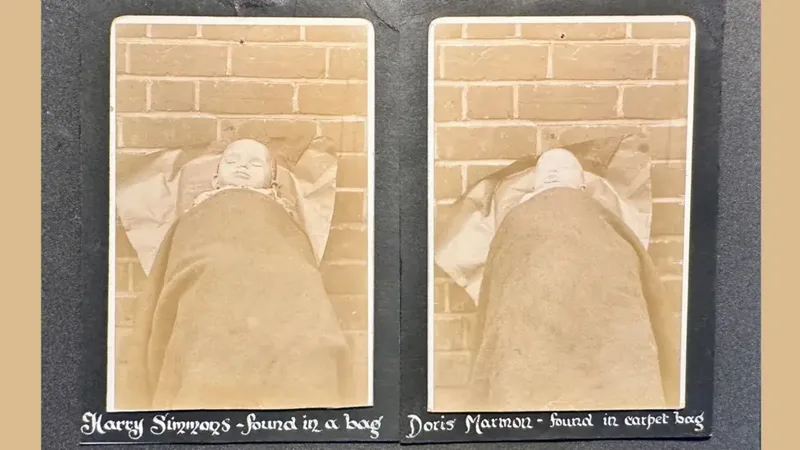
When shown the corpses strangled with cotton tape, Dyer confessed: "You will know which are mine by the tape wrapped around their necks."
To protect her daughter Polly and son-in-law Arthur Palmer from prosecution, Dyer authored a full confession in Reading Gaol, accepting sole responsibility for the horrific crimes which may have involved the murder or involuntary killing of up to four hundred infants.
Amelia Dyer’s trial took place at the Old Bailey on 21st and 22nd May, 1896. She was formally indicted for the murder of Doris Marmon.
The defence argued that Dyer was insane, citing her frequent stays in lunatic asylums and her history of alcohol and laudanum abuse. However, the prosecution demonstrated that her asylum stays were calculated escapes timed precisely to coincide with police investigations, and that her strategic use of aliases proved her sanity and understanding of right from wrong.
It took the jury just 45 minutes to return a guilty verdict. On June 10, 1896, at 9:00 AM, Amelia Dyer was hanged at Newgate Prison by executioner James Billington. Asked on the scaffold if she had any final words, she reportedly replied: "I have nothing to say."
The sheer scale of the suffering uncovered during the investigation highlighted a systemic failure across medical, legal, and social institutions.
The public revelation of Amelia Dwyer's atrocities sent shockwaves through the community of Reading and resonated across Victorian Britain, which was already becoming increasingly aware of the dark realities of baby farming through other high-profile cases of the era, such as that of Margaret Waters and Amelia Sach. Newspapers of the day published lurid and detailed accounts of the proceedings, feeding a morbid public fascination while simultaneously stoking widespread outrage. Citizens and social reformers alike demanded to know how such systemic cruelty could have persisted unchecked within their neighbourhoods. The case forced local magistrates, police forces, and civic leaders to confront uncomfortable questions regarding the lack of regulatory oversight governing the boarding out of infants. The public outcry catalyzed a growing national movement for legislative reform, ultimately paving the way for stricter regulations on child care and adoption practices in the decades that followed, including Parliament passing the Infant Life Protection Act (1897), requiring local authorities to be notified of any adoption involving a child under five years old where a payment was made, giving inspectors the right to monitor care conditions.
It also resulted in the expansion of the NSPCC, which had been founded in 1884, leading to increased public funding and investigative powers for child protection officers. Decades later, the legal frameworks governing adoption were completely overhauled, establishing formal court oversight and ending private, unmonitored financial transactions for children through the Adoption Act (1926).
Despite being convicted and hanged for only the death of Helena Fry, some estimate that Amanda Dyer may be the biggest serial killer in British history, responsible for up to 400 infant deaths.

Comments
No comments yet. Be the first to share your thoughts.
Join the conversation
Log in to leave a comment on inReading.