
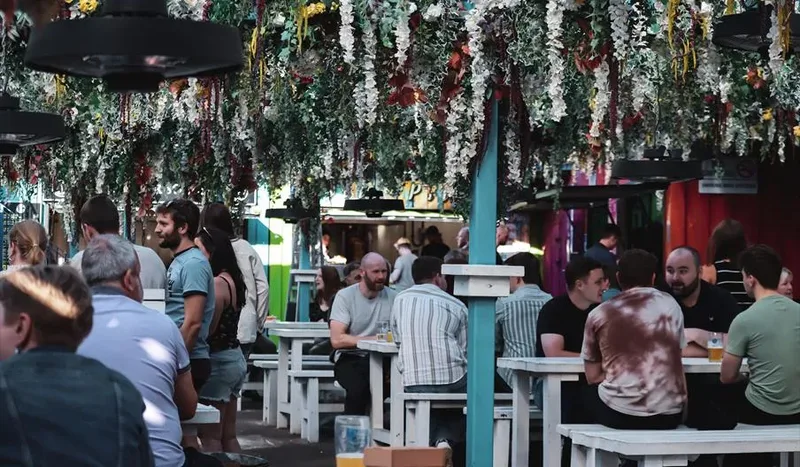
From the gardens of the abbey to biscuit empires and the international dining scene in the town today, Reading’s history is entwined with food. As we launch our food blog, here’s a look back through time at Reading’s relationship with food.
Reading’s location in the fertile and alluvial valleys of the Loddon, Kennet and Thames meant agriculture was the main industry and activity in our area for millennia. The area was rural, dotted with villages, farms and mills.
Market gardening, small farms, orchards, and livestock supplied the local population and neighbouring towns since the first settlers crossed into the UK. Everything was very locally based and the population was largely self-dependent.
In Roman times, there was no town of Reading as we know it. But the Kennet Valley and nearby Silchester — known to the Romans as Calleva Atrebatum — were thriving rural settlements linked by road and river to the rest of Roman Britain. Archaeology tells us that people here lived off the land with a combination of native crops and some imported luxuries.
Bread was the foundation of the Roman diet. Most families relied on coarse loaves made from spelt or emmer wheat (hence Emmer Green), the grains ground on stone mills that left a trace of grit in every bite. Wealthier citizens enjoyed finer, whiter bread made from imported flour. Pulses and vegetables rounded out the meal: broad beans, lentils, onions, leeks, cabbages, and turnips were staples, while Romans introduced new flavours like beetroot, asparagus, and celery to the British table.
Meat was eaten sparingly but prized. Pigs roamed freely through the woods around the Thames and were the most common source of protein, though beef, mutton, and poultry also featured. The rivers teemed with fish — trout, pike, eels — and these too found their way into stews. Dairy farming provided milk, soft cheeses, and butter, while local orchards produced apples, plums, and cherries. The Romans added to this with grapes, walnuts, and the occasional fig or date, delicacies that would have arrived via long, expensive trade routes. In Silchester there would have been the first take-aways - thermopolia were ancient snack bars or fast-food counters. These were small shops or stalls with large terracotta jars (dolia) set into stone counters, which kept hot or cold food ready to serve.
Customers would walk up, buy a portion of stew, beans, bread, or wine, and either eat it standing up or take it away wrapped in cloth or pottery. Most ordinary Romans, especially in cities, didn’t have private kitchens, so these outlets were a vital part of daily life. Some things haven’t changed much.
For sweetness, honey was indispensable; for seasoning, salt, mustard seed, and herbs such as dill and coriander stood in for the exotic spices of the Mediterranean. Only the richest households could afford luxuries like garum, the pungent fermented fish sauce that symbolised Roman refinement.
What the Roman Britons of Reading did not have is almost more striking. There were no potatoes, no tomatoes, no sugar, no rice, and certainly no tea or coffee. Oranges and lemons were unknown, as were the peppers and chillies. Their world was bound by what the climate could grow and what a cart could carry.
The Medieval Table
A thousand years later, the people of Reading were eating in a very different landscape. By the twelfth century, Henry I had founded Reading Abbey, one of the most powerful religious houses in England, and food there was both ritual and sustenance. The monks’ meals followed the strict calendar of the Church: days of fasting, feasting, and abstinence determined what could be eaten and when.
For most townspeople, the diet remained simple. Bread and pottage were the twin pillars of medieval sustenance — bread made from rye or barley for the poor, fine wheat for the wealthy; pottage a thick stew of grains, beans, and whatever vegetables were in season. The poorer you were, the thinner your pottage.
Meat marked the divide between classes. Ordinary townsfolk might have a little salted pork or mutton when livestock were slaughtered in winter. Nobles and abbots dined on venison, goose, pheasant, or swan, washed down with ale or wine. Fish was eaten by all classes, not least because Church law forbade meat on almost half the days of the year. Reading’s rivers and fishponds yielded pike, perch, and eel, while barrels of salted herring arrived from the coast. Royalty and the rich would have hunting lodges in the forests that surrounded the region.
Fruit and vegetables filled the gaps. Apples, pears, plums, and cherries were grown in local orchards; leeks, onions, and cabbages thrived in cottage gardens. The upper classes imported dried fruits — figs, dates, raisins — from the Mediterranean, and spices from even further afield. Pepper, cinnamon, nutmeg, and ginger were not everyday seasonings but symbols of wealth.
Sweetness came, as in Roman times, from honey. Cane sugar had reached England by the fourteenth century, but it was so costly that it was sold in apothecaries as a medicine rather than a kitchen ingredient. The monks of Reading Abbey, however, might have known its taste, blending it into sweetmeats and festive wines on feast days.
Daily drink was almost always ale, safer than the uncertain river water, though cider was common and wine imported for the Abbey’s Mass.
You would eat with a knife, and perhaps a spoon, or with your hands. Forks are a relatively modern invention.
It is hard to overstate how alien our modern pantry would seem to a medieval cook in Reading. The familiar flavours of the New World — potatoes, tomatoes, chillies, sweetcorn, and chocolate — were still centuries away. Rice was a southern luxury, citrus fruits were barely known, and tea and coffee would not arrive in England until the seventeenth century. Sugar, though present, was as precious as gold.
The Age Of Discovery
Before 1492, Europe had never seen a potato, tomato, pineapple, or banana. These foods were native to the Americas (in the case of potatoes, tomatoes, pineapples) or tropical Asia (bananas). The turning point was the Columbian Exchange — the great biological swap that followed European colonisation of the Americas in the 16th century. Spanish and Portuguese sailors carried back seeds and plants to Europe, and Britain eventually followed suit.
By the late 1500s and early 1600s, explorers and traders were bringing specimens home to royal and aristocratic gardens, where they were treated as botanical curiosities rather than everyday food.
The potato was brought to Europe in the late 1500s, probably by Spanish explorers returning from South America. It reached England by around 1590, likely through Sir Walter Raleigh or his contemporaries. For over a century, however, it was regarded with suspicion — a strange underground tuber associated with disease or even witchcraft.
By the late 18th century, the potato had become a British staple. Agricultural improvers like the Earl of Sandwich and Arthur Young promoted it as a dependable crop for the poor, especially after repeated grain shortages. The Enclosure Acts and rise of market gardening around London and Reading helped spread its cultivation westward along the Thames Valley.
In Reading, potatoes appear in market records by the early 1800s, traded alongside turnips and barley at the town’s busy livestock and produce markets. The fertile soils around Caversham and Tilehurst were ideal for early potato growing, and by the Victorian era, Reading’s farms were exporting them via canal and later by rail to London.
Tomatoes were introduced to Europe from Central and South America in the 1500s, but like the potato, they were initially mistrusted — grown as ornamental curiosities in aristocratic gardens. British gardeners considered them “poison apples” until the early 19th century, when cookery books began including tomato sauces and salads.
In Reading, evidence of tomato cultivation appears later still. By the mid-19th century, Suttons Seeds was actively selling tomato seeds to home gardeners and commercial growers, helping to normalise the fruit in the English diet. Reading, through Suttons, effectively became a national distributor of “exotic” produce seeds.
By the 1860s, tomatoes were being grown in greenhouses and kitchen gardens across Berkshire, and they featured in local market produce. Reading households with glasshouses — often supplied by Suttons’ catalogues — began growing them for table use.
The pineapple became the ultimate symbol of wealth and hospitality in 18th-century Britain. Imported through the Caribbean colonies, it was first eaten only by the elite — each fruit could cost the equivalent of several hundred pounds today. Wealthy landowners built “pineapple pits” — special hothouses heated by fermenting manure — to grow them domestically.
While there’s no direct evidence that Reading’s gentry grew pineapples, Berkshire estates such as Basildon Park and Englefield House had heated glasshouses capable of it. The fruits appeared on banqueting tables as centrepieces — often uneaten, admired for their exoticism. Pineapple motifs even crept into architecture (see the pineapple finials on Georgian gates and furniture).
By the Victorian period, improvements in shipping (steam transport and later refrigeration) made imported pineapples more affordable. Reading’s Great Western Railway link (1840) made it possible for tropical fruit from London’s docks to reach the town quickly, marking the first time ordinary residents might have tasted one.
The banana’s route to Britain ran throughout the empire. Native to Southeast Asia, it was introduced to the Caribbean and Central America by Portuguese and Spanish colonisers in the 1500s. By the Victorian era, British-controlled plantations in Jamaica and Honduras began exporting bananas to the UK.
Bananas first reached Britain in significant quantities in the 1870s–1880s, imported by the newly formed Elders & Fyffes company (established 1888). Reading, linked to London by rail and by canal, was soon part of that distribution chain. Grocers at Reading Market and in Broad Street advertised bananas by the early 20th century, often sold individually as luxury items.
By the 1930s, bananas had become a standard treat for British children — until rationing during the Second World War cut off supplies entirely. When bananas returned to the shelves in 1946, Reading’s Co-op stores famously sold out within hours.
Industrial Era Restaurants and Ventures
When you stand by the tranquil towpath of the Kennet & Avon Canal today — willows dipping into still water, ducks gliding past moored narrowboats — it’s easy to forget that this calm artery once teemed with industry and the smells of burning coal and malt being brewed. Two centuries ago, this waterway was Reading’s lifeline, carrying the food, fuel, and raw materials that kept Berkshire fed and connected to the wider world.
Before the age of railways, transport was slow, costly, and perilous. Roads were often muddy and impassable in winter, and moving heavy goods — flour, grain, cheese, or coal — by horse cart could eat into any farmer’s profit. Distributing food was costly and inefficient. Food production tended to be local.
The completion of the Kennet & Avon Canal in 1810 changed all that. Stretching roughly 57 miles from Reading to Bath, and connecting the River Kennet to the River Avon, it opened a continuous route between London and Bristol. The canal effectively turned Reading into an inland port, where food from the west could meet the hungry markets of the east.
The canal was a miracle of practical engineering and social transformation. Along its course, wharves and warehouses sprang up at Aldermaston, Newbury, and Hungerford, each bustling with bargemen loading and unloading sacks of grain, barrels of malt, and crates of cheese. Contemporary trade records list “flour, cheese, timber and malt” among the common cargos heading east toward London, with return loads of coal, iron, tobacco, and even spirits. From Hungerford alone, grain and flour were said to move “in both directions,” as farmers and millers used the waterway both to sell surplus crops and to import essential supplies.
Reading’s long tradition of milling — its riverside mills grinding flour since medieval times — found a new lease of life. Local producers could now send flour far beyond Berkshire, their heavy loads gliding smoothly through locks rather than jolting over rutted lanes. One 1814 chart shows grain and flour “very plentiful” along the route, a sign that the canal had become the backbone of the region’s agricultural economy.
If you’d walked along the towpath in those years, you’d have caught the scent of barley and hops wafting from the malthouses that lined the water. At Frome Road Wharf near Bradford-on-Avon, barges unloaded sacks of barley directly into sloping hatches leading to the malthouse floor. Malt was essential to Britain’s brewing trade — and beer, as one wag put it, was the national beverage because the water couldn’t be trusted. The Kennet & Avon canal thus became a crucial supply line not just for food, but for ale, the daily drink of most Britons.
Cheese, too, travelled by barge — firm, long-lasting wheels that could survive the slow journey to the capital. At Aldermaston Wharf, cargo lists mention cheese bound for London, where demand was growing rapidly in the early nineteenth century. And alongside these local staples came new luxuries: Mediterranean fruits, sugar from the West Indies, even barrels of wine shipped from Bristol and hauled inland to Reading and Newbury. For the first time, provincial England could taste the world — one barge-load at a time.
Not all the canal’s cargo was edible, but much of it sustained food production. Coal from the Somerset pits came eastwards, feeding the kilns that dried malt or powered the early steam engines of Berkshire’s mills. Barges also carried lime, used to sweeten the region’s heavy clay soils. With cheaper transport, farmers could afford to enrich their fields, improving yields and boosting the supply of grain and livestock feed.
The canal helped fuel the quiet revolution in English agriculture during the early nineteenth century. It brought both the tools of production and the routes of distribution together in one shimmering ribbon of water.
By mid-century, the railway had arrived and everything changed again. Trains could move cargo faster, farther, and more cheaply, and the once-busy wharves began to fall silent. But the canal’s influence lingered. Without it, Reading might never have become the industrial hub - in its early decades, Huntley & Palmers’ biscuit factory used the canal to ship its products west toward Bath and Bristol, since biscuits would break if transported by road.
“The Three Bs”: Beer, Bulbs, Biscuits
Reading’s reputation after the Industrial Revolution was based on three food related companies.
It all began in 1822, when Joseph Huntley opened a small bakery on London Street in Reading. That street ran along the key stage-coach route from London to Bath and the West Country. Huntley’s biscuits quickly found favour among travellers stopping at the nearby Crown Inn.
In 1841, the business took a decisive step when Joseph’s son Thomas brought in a young cousin, George Palmer, as a partner for £550. Under Palmer’s energetic direction the firm rapidly expanded and became Huntley & Palmers.
In 1846 the company opened a new factory on King’s Road, converting a former silk mill and establishing what would be for many years the town’s largest employer. By 1900 Huntley & Palmers had become the largest biscuit manufacturer in the world, employing over 5,000 people and producing more than 400 varieties of biscuit.
The biscuit tin was an innovation by the firm. Because coach travellers’ biscuits were vulnerable to damage, Huntley began packaging them in metal tins. Much of the packaging became iconic and are still collectibles on eBay and beyond.
The effect on Reading’s food-culture was profound. The biscuits – often hardy, sweetened pastries or biscuits – became a household item in Reading and beyond. The town even picked up the nickname “Biscuit Town” and the local football club became known as “The Biscuitmen.”
But decline began in the mid twentieth century. Post-war rationing, changing consumer tastes, global competition, and a cramped factory site that could not be modernised all conspired against the firm and production in Reading ceased in 1976.
In the context of food and home life, the rise and fall of Huntley & Palmers reflect the shift from local artisan baking to industrial mass-production, and eventually to globalised supply chains.
Parallel to the biscuits, beer also looms large in Reading’s industrial footprint. In 1785, William Blackall Simonds founded a brewery at Broad Street in Reading; by 1789 this business had relocated to a substantial site on Bridge Street (Seven Bridges) alongside the River Kennet, designed by the architect Sir John Soane.
By the 19th century the brewery, which became H & G Simonds Ltd, was a major employer and supplier not only locally but regionally and internationally. By 1913, for example, it had a large set of tied pubs and a contract to supply beer to the British Army at Sandhurst.
Beer shaped food-culture in a more subtle but no less profound way: in an era before safe bottled water, ale and beer were everyday drinks; malt and barley were local agricultural inputs; the brewery’s demand meant surrounding farms and malting yards prospered. Reading’s workforce in the “Biscuit Town” would often knock off the biscuit factory and walk to the brewery for a pint.
The decline of the brewery followed consolidation in the brewing industry. Simonds merged with Courage & Barclay in 1960. The original Bridge Street site closed in 1980, and the brand name eventually disappeared from Reading.
In terms of food and drink heritage, this means one of the key local providers of brewed drink, malt and barley – integral to the food chain – left the town, and the era of local industrial beer production gave way to national and global brewing conglomerates.
The third of Reading’s famous ‘Bs’ is perhaps the least obviously food-related but still essential to the region’s agrarian and horticultural economy: Suttons Seeds was founded in 1806 by John Sutton as a corn merchant in King Street, Reading, the business diversified into flower and vegetable seeds under the leadership of his son Martin Hope Sutton.
In 1837, the firm moved to the Market Place and increasingly focused on seeds, bulbs and young plants. In 1840 Suttons had established a laboratory in Reading to test seeds for germination and purity - long before such standards became law in 1920.
Although the products were horticultural, rather than food itself, they were deeply connected to food-production: vegetable seeds and bulbs enabled local gardens, allotments and farms to produce fruits and vegetables. As you have read, tomatoes were popularised as a domestic grown plant largely by Suttons. In an era when food supply was less global, enabling local growth of quality produce helped food security and local diets.
However, Suttons eventually moved out of Reading (to Torquay in 1976) and the seed business here also diminished.
Together, the Three Bs transformed Reading’s identity and economics. For the biscuit industry, mass manufacturing meant large-scale employment and the supply of biscuits nationally and internationally. For beer, the brewery and associated malt and barley inputs were central to the regional agricultural and food chain. For seeds and bulbs, the facilitation of vegetable and plant production contributed to local food-production and gardening culture.
Little legacy remains: almost all the the Huntley & Palmers buildings have now been flattened and a few collectors’ biscuit tin and a gallery in the Reading Museums are now all that remains; the brewery site is now the Oracle shopping centre; the seed-company records are held at the Museum of English Rural Life in Reading. How tastes change.
Eating Out After The War
The bombing of The People’s Pantry in Marketplace during the Second World War is well documented and after the war there was a period of restrictions and rationing.
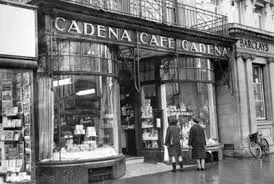
Gradually, new places to eat and go out that were not a pub started to appear in our town - new restaurants such as the Cadena Café at 100 Broad Street opened, offering afternoon tea or coffee and cake.
Two locals, John Day and Liz Rebbeck gave inReading a rundown of the restaurants they remember with the aid of some Kellys Directories from the last century!
They reckon that Rafina in West Street, and recently reviewed in these pages, is the oldest surviving restaurant in Reading – it was certainly in the 1972 directory and could have been there earlier.
Most of the others have now long disappeared. The most recent to close was Munchees at 4 Butter Market, which had been there since the early 70s but closed in March 2025.
Not surprisingly, one of the earliest restaurants in town and around from the 1940s was Pictons Fish Restaurant at 30/31 St Mary's Butts, known for its “very nice fish and chips” according to our commentators.
The Platters coffee shop at 20/22 Cross Street was there in 1970 as was greasy spoon Leaties Café at134/135 Friar Street on the corner of Union Street (Smelly Alley). Back then there was also a branch of the famous J Lyons tea rooms at 40 Broad Street.
Sally's Café, 15 Harris Arcade. In 1949 directory but not in 1970. If you 'Google' Sally's Café Reading and stroll down to an article by Berkshire Archaeology Group there is some very interesting stuff about Baroness Erisso, Marianne Faithfull and the Rolling Stones ! I was told that Baroness Erisso also owned the Carillon Restaurant above a row of shops at Cemetery Junction between Eastern Avenue and Granby Gardens but I haven't been able to verify this.
Broad Street Mall used to have a Food Court during the 1980s situated on the upper level. Various kiosks selling different types of food, and chairs and tables in the middle.
The Regent Café 55/56 St Mary's Butts was one of the original Italian owned food shops in town from the 60s, owned by Gino Tognarelli and famous for its ice cream.
Till's Café at 17/19 London Street was a quite large, plain eating place opposite the old Reading Transport bus depot ("The Tramways" was just over the road in Mill Lane before it was levelled for the oracle car park and popular with the bus staff who went there for meals between shifts.
On the corner of St Bartholomew's Road and Wokingham Road, opposite Palmer Park in the spot that is now vacant but recently was O Portuges! were the Colley's Supper Rooms where the waitresses wore Victorian style dress and would bring round samples of mains dishes before customers placed their orders. Starters were laid out for customers to help themselves. Apparently “there was an astonishing array of items and it was easy to get carried away and eat too much !”
Immigration and Internationalisation
The wave of migration, especially after WWII, introduced new cuisines. A notable case is the arrival of Italian migrant communities, established after there was a significant number of prisoners of war working in the Huntley & Palmers and elsewhere. Italian foods like pasta, salami, and cheeses were brought by migrants in Reading’s ‘Little Italy’; small businesses like “Antonio the Pasta Man” sold goods; and the first Italian restaurants appeared. Over time these became integrated into the fabric of local food culture.
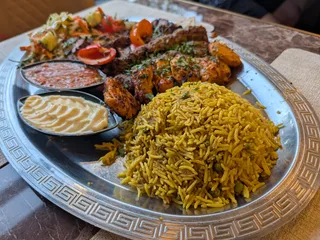
We believe that the first Indian restaurant in Reading was the Taj Mahal Indian Restaurant at 115 King's Road in the late sixties – the building demolished when Forbury Road was widened and the 60s also saw the arrival of the other exotic restaurants such as the Eagle Chinese restaurant in Chain Street as a precursor to the extensive choice of food from all over the world we have today. On King’s Road alone there are restaurants from Mumbai, Kerala, Chennai, Sri Lanka, Hyderabad, Nepal, Vietnam and Thailand.
More recently, Eastern European restaurants such as the Polish Piwica and the Romanian traditional Romanesc restaurants have appeared, along with African, Egyptian, Caribbean and Brazilian influenced cafes.
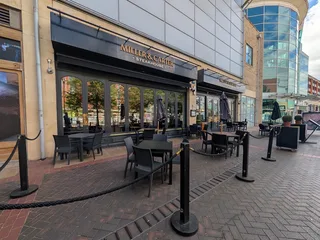
Of course, multinational chains have taken over most central town locations offering a predictable range largely based on burgers, fried chicken and pizzas.
At the same time traditional food shopping streets such as ‘Smelly Alley’ have given way to supermarkets and ethnic food shops at St Mary’s Butts and Oxford Sreet.
The story of Reading through food is a fascinating one that is still evolving as the rise of home delivery companies results in the latest changing trend in eating in Reading.
Comments
No comments yet. Be the first to share your thoughts.
Join the conversation
Log in to leave a comment on inReading.