
Children, as we know, can be picky eaters, but my half-French wife has always been confounded by the British way of letting kids choose their own food, so that they inevitably end up with chips. In France, from an early age, kids eat what grown-ups eat. As indeed they do in many other cultures.
In the US and UK this has resulted in a total change from the tradition where everyone ate the same, which existed for millennia. The move towards 'child-centred' education and child-rearing reinforced this and now kids seem to live on chips and anything beige.
In Japan, picky eating is much less common due to a formalised cultural focus on shokubiku (food and nutrition education). Children typically eat the same smaller portions of adult meals, and communal eating in structured environments - like preschools - discourages individual food refusals or requests for alternatives.
Since we eat out most regularly with her sister and family, this is an issue which still has my wife in despair, but the mould has been set and you can only hope that time will bring a change.
My twelve-year-old niece is not only fussy but also vegetarian. She eats bread, chips, most fruit, broccoli, sweetcorn, peas and raw carrots. My nephew will add chicken or fish goujons to that list. But once he did mention to me that he liked chicken chow mein at school and it was not an opportunity I could let pass.
He was on one of those teacher training days at the tail end of half term and his mum asked if I'd like to take him out since she was working from home and they were just back from Eurodisney, a trip we had missed due to my wife's work commitments.
He is a mature and kind boy who looks and acts older than his seven and a bit years and I adore spending time with him, so I jumped at the opportunity and decided to use it as an excuse to expand his culinary experiences.
Instead of being restricted to places that do chips and margherita pizzas, here was a chance for rice and noodles. But where to go on a Monday lunchtime? Kei's over in Earley was shut and none of the central Reading Chinese could be depended on for traditional Cantonese-style chicken chow mein - that foodstuff of the traditional Anglo-Chinese takeaway of our youth.
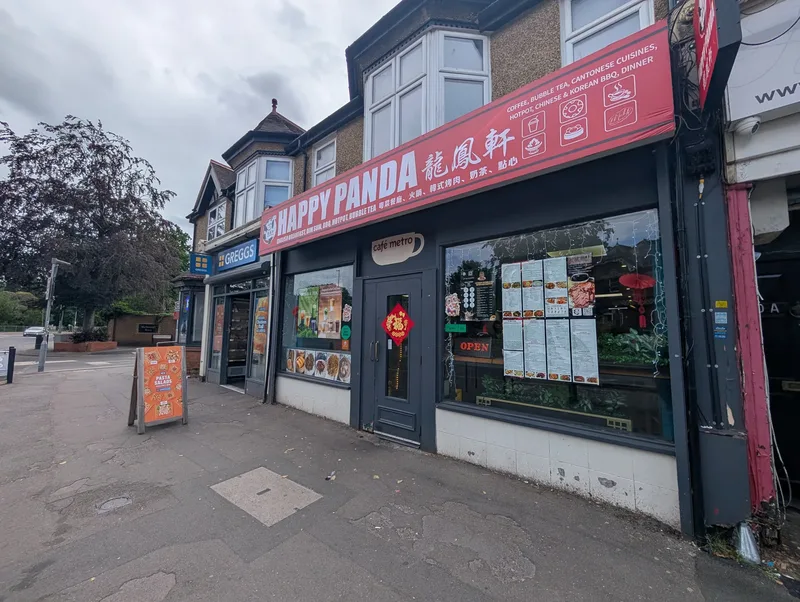
I asked Google (or rather Gemini these days) and it directed me to the university, where with term time over there was parking space and we had a choice between Happy Panda and Kungfu Kitchen, the mini empire built by the inimitable Joanna Hu since arriving In Reading over a decade ago.
A lot has been written about Kungfu Kitchen and its Shandong food. It has even had positive write-ups in the national press.
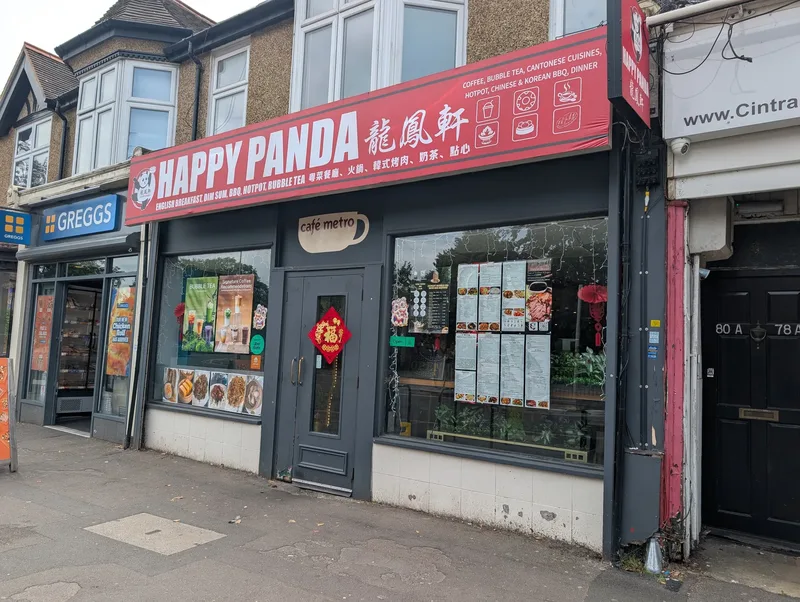
But I decided that it was probably a step too far and that the more bland Cantonese-orientated Happy Panda would be a better choice. It occupies the space once occupied by Kungfu Kitchen which moved several doors up the parade on Christchurch Road.
By the door there is a water and smoke-spewing shrine, which was immediately exciting for a seven-year-old.
I remember when my gran first took me to the Chinese in Bangor, North Wales and at the same age I was fascinated by the waterfall, pool and giant goldfish indoors!
The menu will be familiar to anyone who has frequented UK Chinese restaurants since they first arrived in the UK in the late 19th and early 20th century. Britain’s thriving maritime trade brought thousands of Chinese merchant seamen to major port districts like London’s Limehouse, Liverpool’s Pitt Street, and Cardiff’s Tiger Bay. Tucked away in these industrial hubs, the very first eating houses were modest boarding-house cafes and tea shops catering for the immigrant and transient populations. The British link with Hong Kong inevitably meant that they featured Cantonese food from Guangdong province, adapted to local ingredients where necessary. It is not very spicy and uses ginger, scallions, garlic, soy sauce, rice wine, and oyster sauce for flavourings. Dim sum, roasted meats (siu mei) and fresh seafood are core to the cuisine, often combined with fresh vegetables in a wok.
The transition of UK Chinese food from isolated dockland enclaves to a mainstream high street culinary institution was accelerated by the devastation of World War II. Heavy wartime bombing decimated the original riverside Chinatowns of Limehouse and Liverpool, forcing these communities to migrate inland. This relocation coincided with a massive post-war wave of Cantonese immigrants from Hong Kong in the 1950s and 1960s. Settling into areas like Soho in London, Nelson Street in Liverpool, and across the South Wales valleys, these resilient families brilliantly adapted their business models to survive.
To capture the British public’s imagination, early restaurateurs cleverly adjusted their menus, introducing sweet, savoury, and accessible Cantonese classics. In regions like Wales, many took over traditional fish-and-chip shops, blending English chippy staples with adapted Chinese dishes and the now-legendary curry sauce. This evolution from survivalist dockside kitchens to the ubiquitous high-street takeaway fundamentally reshaped the UK's culinary fabric, paving the way for the rich, authentic, and diverse dining experiences we enjoy today.
In Reading we have the traditional Wing's Fish Bar around the corner from the recent Cantonese sensation, Good Old Days on George St and even on Broad St you will soon be able to mix and match largely Cantonese flavours in Chopstix as it extends its operating licence until the wee hours.
So the menu at Happy Panda will be familiar to most Brits - from Lemon Chicken to Chicken Chow Mein, and also appeal to the growing Hong Kong community in our town. Jop has even finally succumbed to the big delivery firms and you can now Deliveroo a Happy Panda!
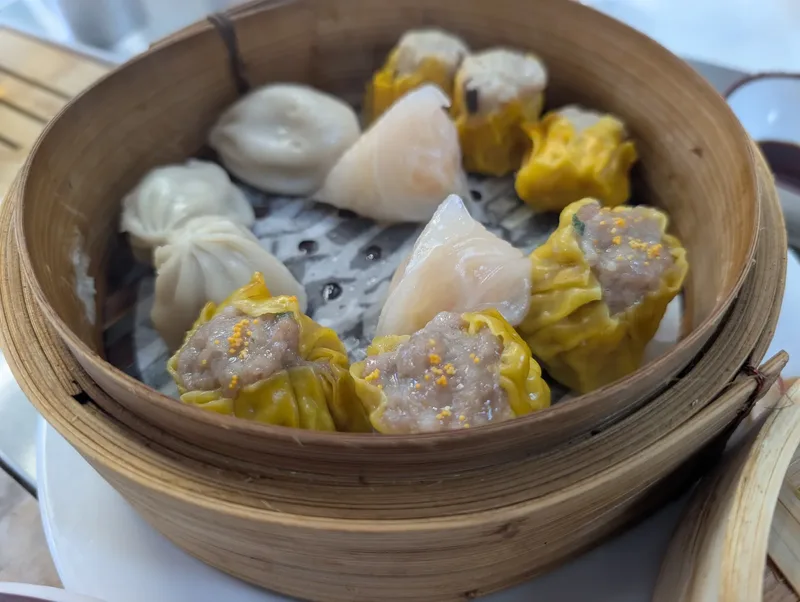
The menu has a good list of dim sum and I couldn't resist the mixed starter, which had chicken and beef shu mai, prawn pad gao and three pork dumplings with the requisite side dish of vinegar for dunking. It was more than a meal in itself and my nephew demurred, seeing the little packets of deliciousness as a step too far from familiar territory. I was a bit disappointed but wasn't going to do the Chinese persuasion thing and he definitely wasn't going to be looking at his screen for this meal.
They were chunky and perfectly steamed; I particularly liked the chicken siu mai with its bits of mushroom rather than the more familiar prawn and pork filling (often with water chestnuts for bite).
Of course I dunked them in chilli oil rather than the vinegar and kept most for lunch the following day.
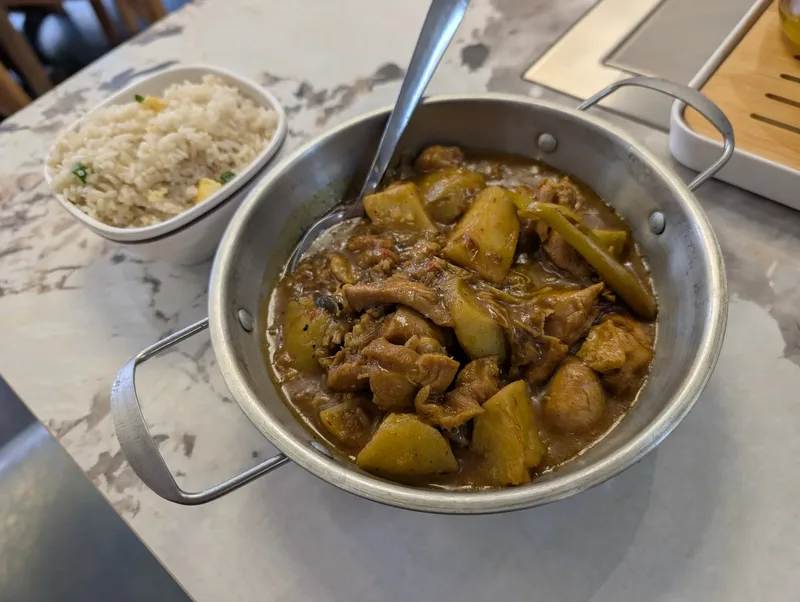
My Malaysian Curry was a bit of an off-piste choice but I was interested to see what it would be like. As it happens it was the child of a Massaman Curry and one of those Chinese Chip Shop curries of youth.
It was very potato heavy and the potatoes were not pleasant - they had either been over-chilled or even frozen. It was a bad choice and was not similar to anything I had eaten that purported to be a curry from Malaysia.
The side of fried rice was so-so - slightly tasteless, lacking egg, oyster sauce and sesame oil.
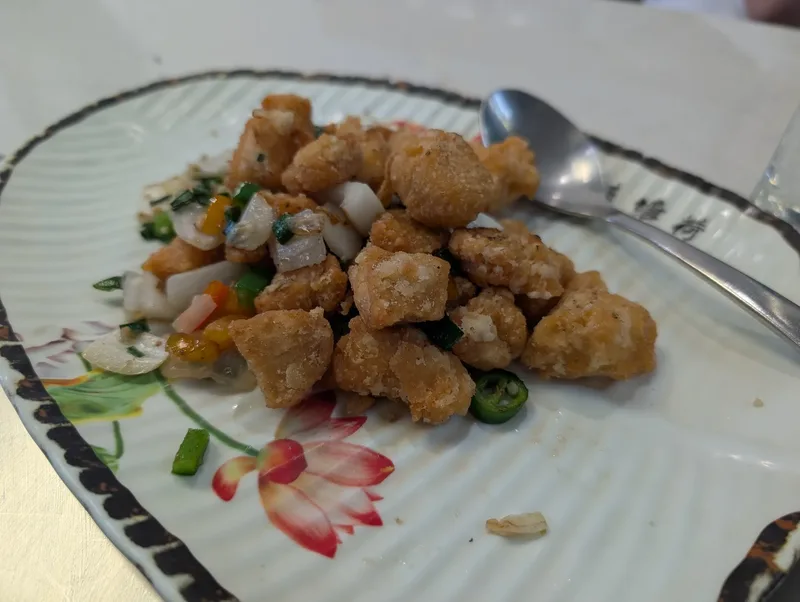
But forget me, onto the important review. My nephew loved his salt and pepper chicken, which were small and crispy, firm and very salty, albeit not quite peppery enough for my taste. I picked away at the finely chopped onion, chilli and peppers that they sat on and lifted the flavours. My nephew studiously avoided them and seemed very content.
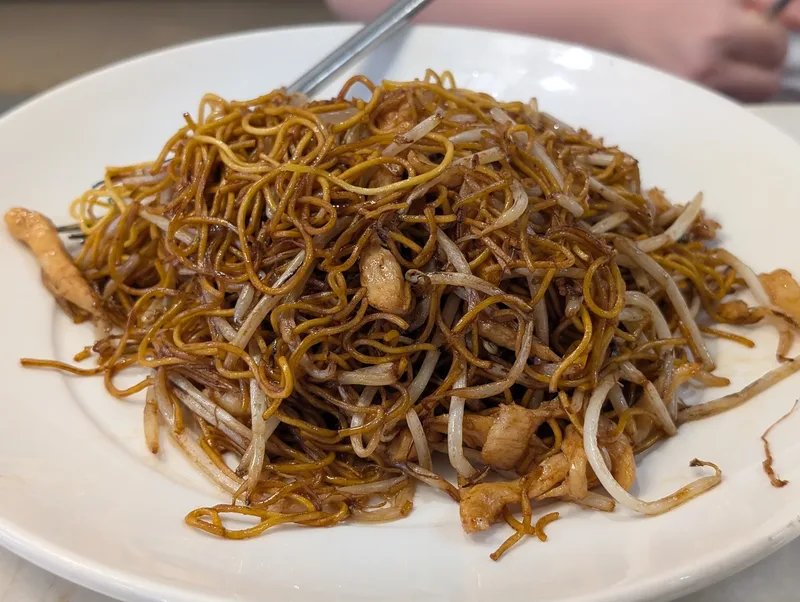
Even more so, he thought that the chicken chow mein, a simple dish of thin egg noodles, some onion and chicken in a soy-heavy sauce was delicious, exclaiming so loudly to the delight of our lovely waitress, who was not overly taxed by the three or four tables occupied on a Monday lunchtime?
Cornflour, MSG, salt and soy were present, as they should be, they are staples of the Cantonese kitchen cupboard. I regretted not ordering some broccoli, which my nephew also loves, or something fresher. The tendency with Cantonese (if you're me, at least, is to go for the not-so-healthy options).
I had my usual pot of jasmine tea which came in a funky plastic teapot and plastic microcup. At least the pouring worked - most tea in traditional china seems to end up on the table in my experience.
During the meal I started to teach my nephew how to use chopsticks - he had some success, but I think that we are going to have to make some more return visits to get him fully dexterous with them.
If this visit was anything to go by then his culinary horizons have expanded some and we did leave as Happy Pandas! All we need to do now is to find a Chinese that offers chips and margherita pizzas for the young fellow's sister....

Comments
No comments yet. Be the first to share your thoughts.
Join the conversation
Log in to leave a comment on inReading.