
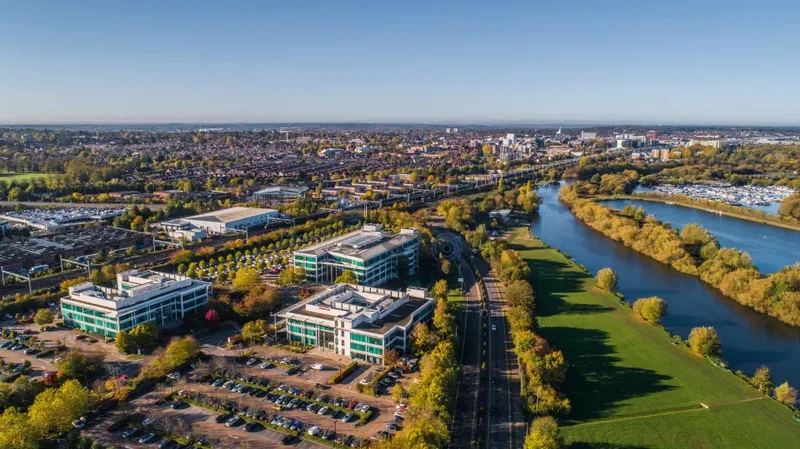
After months of protracted debate and shifting alliances across our region, the question of how the Thames Valley will govern its future has taken a decisive turn. On 26th October 2026, all thirteen council leaders across Berkshire, Oxfordshire, and Swindon submitted a joint letter to central government confirming their backing for a Thames Valley Mayoral Strategic Authority. The submission formally pitches for a devolution deal with Westminster that includes an elected regional mayor, with voters expected to go to the polls as soon as 2028.
In response, as part of the Budget on 28th October, the Chancellor of the Exchequer, John Healey, announced an allocation of £9.1m of funding to take the initiative forward by preparing a detailed plan before entering a consultation phase later this year.
For those of us living and working in Reading, the move represents a striking shift in direction. Only weeks ago, Berkshire appeared set to go it alone, having launched the Berkshire Prosperity Board and appointed Saba Tahzib as Director of Devolution and Growth on a £130,000 contract. The board built a dedicated public portal and began managing shared services, seeking to preserve the town hall autonomy established when Berkshire County Council was abolished on 1 April 1998. Meanwhile, the integration of some parts of West Berkshire into a new Ridgeway council will proceed. Confused? It seems that the endless shuffling of local government is about to be supercharged under the new devolution-friendly PM.
Central government ministers had made clear that the largest devolved capital budgets, particularly for multi-billion-pound infrastructure and regional transport networks, remain reserved for areas with direct mayoral accountability. Facing the government's funding cut-off ahead of the autumn budget, local leaders resolved their longstanding disagreements over geography and governance to ensure the Thames Valley did not forfeit its place in line and submitted their bid just a couple of days before the end-of-October deadline.
Berkshire’s six unitary authorities - Reading, West Berkshire, Wokingham, Bracknell Forest, Windsor & Maidenhead, and Slough - were potentially left to negotiate directly with Whitehall for devolved cash without an elected figurehead. Now they have teamed up with Oxfordshire and a major stumbling block was overcome when the authorities agreed to include Swindon in the bid. Apparently, it had been made clear by Parliamentary Under-Secretary of State for Devolution, Local Growth and Communities, Nesil Caliskin MP, that the region should apply but that the bid would only be viable if Swindon was included.
Overcoming the Summer Deadlock
The joint submission marks a breakthrough after plans almost collapsed earlier in the year. In June 2026, cross-boundary proposals stalled when Oxfordshire leaders pulled back, split over whether Swindon should join the partnership and divided on the timetable for establishing a mayor. Ministers warned that leaving Swindon out would weaken the economic coherence of the M4 corridor, urging all parties to find common ground.
When that agreement finally arrived in late October, Oxford City Council Leader Susan Brown is reported as saying that the proposal would bring billions of pounds of investment to the Thames Valley and would be enormously beneficial to the region.
Swindon's leadership also welcomed the united front. Councillor Jim Robbins, Leader of the Labour Group in Swindon, is reported as welcoming the move: "Really pleased to hear that Swindon may have made a breakthrough on our devolution plans! All of the parties in Swindon, Oxfordshire and Berkshire have come to an agreement on the geography of the Thames Valley region."
Reading Borough Council Leader Councillor Liz Terry announced: “I am delighted with today's news, this is a significant step towards harnessing the opportunity and investment to grow and develop our region.”
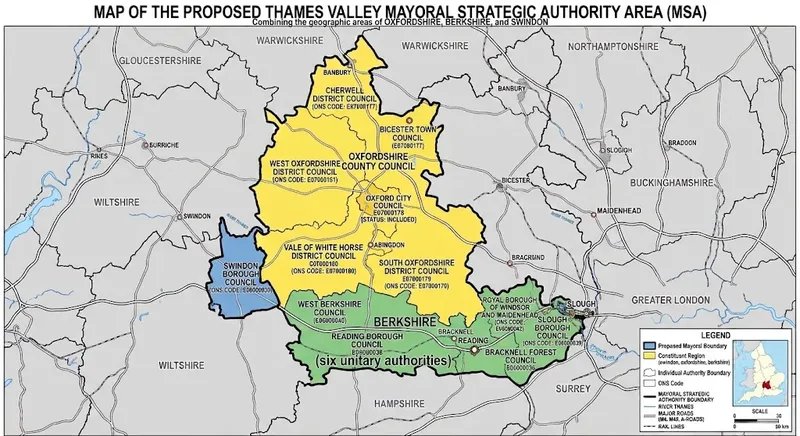
Map of proposed mayorality (generated by AI, may have inaccuracies)
What a Regional Mayor Means for Reading
At the geographic and commercial centre of this proposed authority sits Reading. Our regional economy generates roughly £97bn annually, but addressing our biggest headaches - such as cross-Thames road capacity, gridlock around the M4, the supply of genuinely affordable housing, and specialist skills training - requires decisions that reach well beyond borough boundaries. A third bridge for Reading may become a priority if the mayorality is approved.
In Reading, RBC Leader Liz Terry and Chief Executive Jackie Yates have consistently argued that cross-boundary alignment is essential. Speaking earlier this autumn about joint regional working, Jackie Yates noted: "By working collaboratively we will be in a much stronger position to tackle those challenges. A Mayoral Strategic Authority provides the legal vehicle and financial scale to turn that collaboration into long-term infrastructure delivery."
Crucially, existing council responsibilities do not vanish. Reading Borough Council will retain direct control over statutory day-to-day services, from local bin collections and adult social care to town planning and primary education. The regional mayor’s focus will concentrate strictly on strategic powers transferred down from Whitehall rather than pulled up from local civic offices: large-scale transport franchises, spatial planning, regional decarbonisation schemes, and central skills funding.
Meanwhile, the practical programmes initiated by Berkshire’s unitary councils now targeted via the Berkshire Prosperity Board will, they claim, form the baseline of the new regional structure. Private enterprise will continue to feed commercial insight into policy through the Berkshire Business Board, chaired by commercial lawyer Penny Rinta-Suksi. But the initiative may well be usurped by these latest developments. Indeed, the addition of another layer of local government may itself be questioned. Reading already has its own economic development organisation, REDA.
A Regional Powerhouse?
Arguably, the region provides one of the most attractive inward investment areas in Northern Europe. Oxford provides the research and development, Reading provides the highly qualified workforce and office spaces, Slough provides those all-essential data centres and from the age of the railways to modern car manufacturing, Swindon is a strong manufacturing centre. The combined authority would handle regional decision-making and funding for transport, housing, skills development, and economic growth along the M4 corridor, so there is considerable potential to use the new structures to benefit the region at a time of increased economic uncertainty and change. The area is already the second biggest economic area in the UK outside of London, but it has been made clear that central government is keen for more investment to go to Northern England.
The Road to 2028
Once the local plans funded by the new award are finalised, public consultation will follow, giving Reading residents, business owners, and community groups an opportunity to scrutinise the exact powers and budgets on the table before the authority formally takes shape. Should the plans pass local muster (although, as ever with central government decisions, it is easy to be cynical about the amount of input local people actually get), and following approval by the Department for Housing, Communities and Local Government, Ministers must formally approve the proposed boundaries and draft the statutory instruments required to establish the Thames Valley Mayoral Strategic Authority. It will certainly be a lot of work for civil servants and, no doubt, a lot of highly paid consultants.
If Whitehall approves the scheme, the region will spend the next eighteen months establishing its shadow administration, setting the stage for voters across Berkshire, Oxfordshire, and Swindon to choose their first Thames Valley Mayor, possibly as early as May 2028.
You can read more about Reading Borough Council's take on devolution here.
Comments
No comments yet. Be the first to share your thoughts.
Join the conversation
Log in to leave a comment on inReading.